











PODCAST: Healing from Lyme requires a nervous system that feels safe

By Fred Diamond
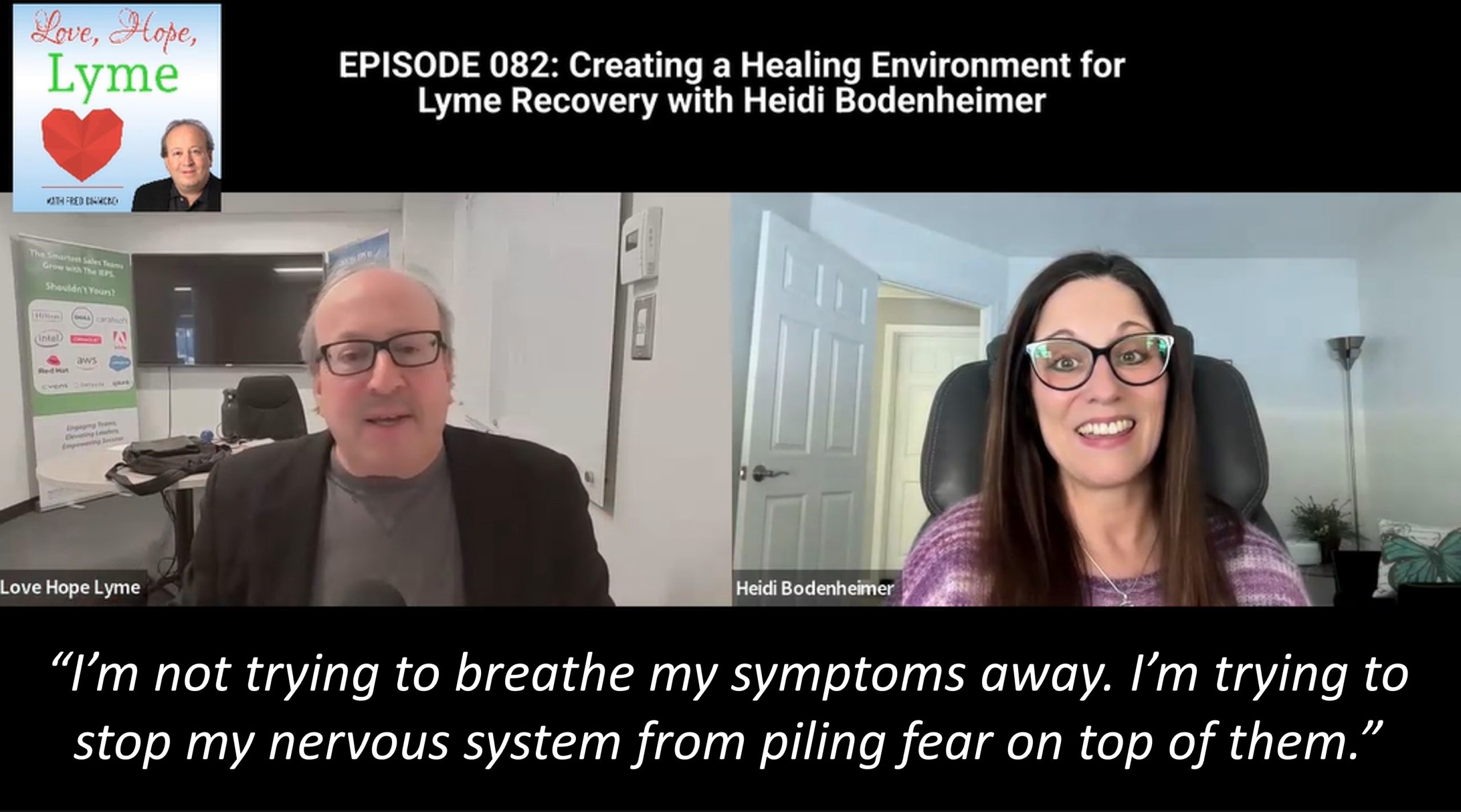
On this week’s episode of the Love, Hope, Lyme podcast, health coach and Lyme survivor Heidi Bodenheimer shares a message that resonates deeply with many chronic Lyme survivors: healing is not just about protocols, supplements, or finding the “perfect” doctor. It’s also about getting your body and mind feeling safe enough to heal.
Heidi, who has spent the last eight years navigating her own Lyme disease journey, has worked with thousands of clients as a board-certified health coach. Her approach focuses on what she calls creating “the most hospitable environment for us to heal.”
“I’m not speaking about this from a distance,” she says. “I know what it’s like to do all the research, to try all the things, and to still have days where my body is just not cooperating.”
A painfully familiar Lyme story
Before becoming sick, Heidi spends decades in the fitness industry, teaching up to 10 exercise classes per week. But despite her commitment to health and movement, her body eventually stops cooperating.
“That was a frustrating experience for me,” she says. “When you’re doing all the things, I’m supposed to be the leader of this, yet here I was, I wasn’t able to do the classes.”
At first, she tries to push through the symptoms.
“I thought, ‘If I could just push through, I’ll just push through. I can do this.’”
But Lyme disease has other plans.
The soreness she experiences becomes relentless. What once feels like normal post-workout fatigue evolves into debilitating pain and flu-like symptoms that never fully resolve.
“I was sore, the kind of sore that when you run a marathon or something,” she recalls. “Mine never went away.”
Overwhelming exhaustion
“Anytime that I would push too hard, I would find myself in this predicament where a workout session would then cost me maybe seven to ten days.”
Eventually, the fatigue, pain, and malaise leave her bedridden.
“It happened over and over and over,” she says.
Today, Heidi approaches movement very differently. Instead of intense workouts, she focuses on stretching, Pilates, and honoring the signals her body gives her.
“This is where we really need to honor our bodies and listen to our bodies,” she says.
That mindset becomes the foundation for the CARES framework she develops for chronic illness survivors.
Healing starts with the nervous system
Importantly, Heidi emphasizes that CARES is not a substitute for medical treatment.
“This is a support structure,” she explains. “Really, it’s for our nervous system, it’s for our mindset, it’s our daily choices.”
The first part of CARES is “C” for calm the body and mind.
For Heidi, that starts with breath work, specifically the 4-7-8 breathing technique.
“What I like about the 4-7-8 breath is it gets us to that parasympathetic nervous system very, very quickly.”
Her instructions are simple: inhale through the nose for four counts, hold for seven counts, and exhale for eight counts, repeated four times.
“That is a really fast way to downshift the nervous system,” she says.
For people with Lyme living in chronic fight-or-flight mode, calming the nervous system can be transformative.
“When the body is in threat mode, the brain gets really, really noisy,” Heidi says. “We go into catastrophic thinking, we get irritable, we don’t sleep.”
She is quick to clarify that breathing exercises are not about pretending symptoms don’t exist.
“I’m not trying to breathe my symptoms away,” she says. “I’m trying to stop my nervous system from piling the fear on top of them.”
That distinction matters.
Many with Lyme struggle not only with the infection itself, but also with the fear, uncertainty, and overwhelm that accompany chronic illness. Heidi believes nervous system regulation is foundational because healing cannot happen effectively when the body constantly feels under attack.
Winning the next 10 minutes
The second part of CARES is “A” for Ask What’s Important Now, which she calls the WIN method.
“There’s a lot of complexity that goes on with Lyme or any kind of chronic illness,” she says. “There’s a lot of overwhelm.”
Instead of trying to solve everything at once, Heidi encourages survivors to narrow their focus to how you can win the next 10 minutes.
Sometimes the answer is hydration. Sometimes it’s sunlight. Sometimes it’s breathwork. The key is reducing overwhelm and taking manageable steps.
Heidi also emphasizes the importance of boundaries and communicating needs clearly to loved ones.
“Maybe today is a low-capacity day for me,” she explains. “I need to communicate that to the other person.”
Reframing the internal dialogue
The “R” in CARES stands for reframing thoughts through what she calls the self-coaching model.
Using the acronym CTFAR (circumstance, thought, feeling, action, result), Heidi helps clients recognize how their internal dialogue shapes their emotional and physical responses.
“If I have the thought, ‘This means I’m never going to get better,’ then the feeling is definitely going to be hopelessness,” she says. “Then I’m not going to take the action I need.”
For many Lyme survivors, reframing does not mean forced positivity. Instead, it means recognizing destructive thought spirals and interrupting them before they deepen despair.
The power of non-negotiables
The “E” in CARES stands for essentials.
Heidi encourages clients to identify three “non-negotiables” they can commit to even during severe flare days.
“I always make them very, very small,” she says. “Pick three things that you can do even on a flare day.”
For her, those essentials include breath work, meditation, and gentle movement.
This concept is especially powerful for Lyme survivors who often feel defeated when symptoms disrupt routines or productivity. Rather than expecting perfection, Heidi focuses on consistency.
“Consistency over intensity any day of the week,” she says earlier in the conversation.
Giving yourself grace and space
Finally, the “S” stands for self-compassion, which Heidi calls her favorite part of the framework.
“We’re always going to have some limitations with Lyme,” she says. “Sometimes we’re going to overexert, sometimes we’re going to crash.”
Instead of responding with shame and self-criticism, she encourages survivors to give themselves “grace and space.”
Her GRACE model includes grounding in reality, releasing shame-based “should” language, allowing what is true, choosing kindness, and encouraging the next 10 minutes.
“I’m in the process of figuring this out,” she says, offering an example of the type of self-talk she encourages.
Healing is rarely linear
Throughout the conversation, one theme continually surfaces: healing from Lyme disease is rarely linear.
There are setbacks, flare days, emotional crashes and moments when progress feels invisible.
But Heidi believes survivors can still create an internal environment that supports healing rather than fighting against it.
“At the end of the day,” she says, “it’s those three non-negotiables that you’re saying, ‘Hey, I’m going to do this even on a flare day.’”
For Lyme survivors exhausted by complexity, CARES offers something refreshingly practical: small, repeatable actions rooted in nervous system regulation, compassion, and realistic consistency.
And perhaps most importantly, it offers a reminder many chronic illness patients desperately need to hear:
You do not have to heal perfectly to keep moving forward.
Click here to listen to all episodes of the Love, Hope, Lyme Podcast or on YouTube.
Fred Diamond is based in Fairfax, Virginia. His popular book, “Love, Hope, Lyme: What Family Members, Partners, and Friends Who Love a Chronic Lyme Survivor Need to Know” is available on Amazon. The e-version (pdf) of the book is always free to Lyme survivors. PM Fred on Facebook or LinkedIn for your copy.





We invite you to comment on our Facebook page.
Visit LymeDisease.org Facebook Page