















After 200 tick bites in one day, I invented a better way to stay safe
By Paul Elias
I trained as a field biologist at Berkeley and Harvard and am part of a huge extended family summer community on the Elizabeth Islands in Massachusetts (like 500 cousins).
My son and I both contracted Lyme disease on the islands years ago. Many of my cousins have had every known tick-borne illness, as well as the alpha-gal meat allergy.
We have long had dog and deer ticks (blacklegged ticks) and in the past decade, lone star ticks have appeared as well.
A history of failed tick‑control efforts
The Elizabeth Islands have seen a century and a half of attempts to control ticks and disease with little success.
These include introducing special tight cuffs and collars on children’s clothing in the 1850s, bringing parasitic wasps from Europe in the 1920s, using cardboard tubes with treated cotton in the 1990s, inventing tick draggers to clear ticks from trails in the 2010s, and using permethrin spray, permethrin soak kits, and pretreated gaiters and socks since about 2000.
The islands have also worked for decades with academic experts Sam Telford and Tom Mather and are a study site for the Mice Against Ticks project at MIT.
I concluded that given the growing array of illnesses we could contract (sometimes three from one tick bite) the right answer was NOT TO GET BIT! I wanted to head troubles off before they started.
I also came to see ticks as hypodermic systems that injected whatever they had ingested, and I feared what new pathogens might be coming down the pike at us forever.
The turning point
After I was bitten by about 200 newborn lone star tick larvae ten years ago, I itched terribly for more than a month. At that time, I swore that I would find some means to prevent the bite of any tick species at any stage of life from larva to adult.
That winter we visited friends in India and hiked in the Ghat mountains. There we were given “leech socks” by the guide to protect against small terrestrial leeches known to plague hikers in the region.
These were heavy cotton over socks that we pulled on and tied with a drawstring below the knee. At the end of the hike, we shook many frustrated and hungry leeches out of our shoes.
The idea of complete coverage over the entire foot and calf seemed like an excellent approach for ticks because, like the leeches, they typically alight on the lower leg and foot.
The leech socks had been too thick, tightening my shoes uncomfortably, the drawstring did not hold well so the sock slid down to my ankle, and the cotton got wet and never dried, so there were many things that needed refinement, but the core idea seemed good.
Searching for the right materials
When I got home, I spent the winter testing tech fabrics to find something super-breathable and cottony, but also super-sheer so that it could not be felt in the shoe.
I wanted something light but tough, with a tightly woven fabric that tiny ticks could not penetrate. I wanted a broad adjustable elastic strap to hold the over sock comfortably and effectively, and I wanted a fabric that accepted permethrin treatment well.
Finally, I needed a way to stop ticks crawling up from the lower leg to find skin above the knee.
Over the following year, I tested many solutions and made prototypes available to my cousins. I finally found a parachute fabric that met my criteria — comfortable, fast drying, light as a feather, highly breathable, but with a tight weave.
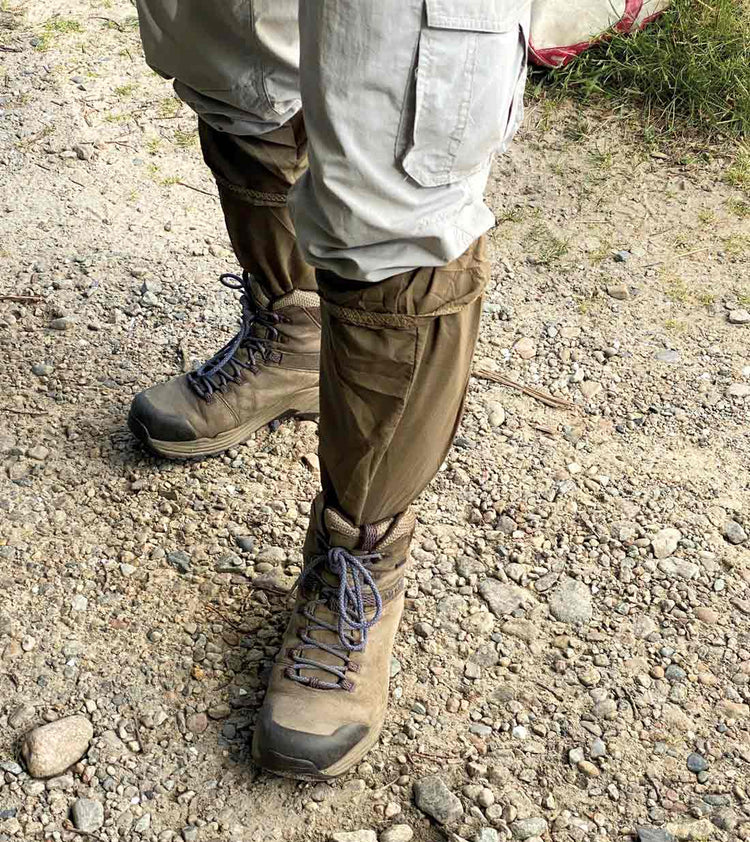
I also did many experiments with ticks (I had an ample supply) and recognized that ticks cling tight to the surface as they climb. Thus, if I folded the top of the over sock back down over the strap at the knee, it would trap climbing ticks in a kind of dead end under the turndown.
A tick in that situation is physically stopped from climbing higher and is also increasingly disabled by the permethrin treatment, resulting in the tick dropping off, and often dying. Of course, if a tick alights above your knee, you still need treated pants and shirt, but the protection of the lower leg and foot solves a lot of the problem.

Author Paul Elias wearing his Ticktogs.
Refining the prototype
Over the next few years, I made up a few dozen pairs a year on nights and weekends in my basement, as I adjusted the design and materials. The result was christened “Ticktogs.” When I retired last year, I thought that I should use my time to make these more broadly available. So I had a couple thousand pairs made up in Fall River, Massachusetts, and had them treated at Insect Shield’s facility in North Carolina.
They are available both on Etsy and at my Shopify site at Ticktogs.com. I am learning about garment production as I go and am still mystified by online marketing. However, I am determined to help people avoid tick bites and to offer what has worked well for my extended family to others.
I don’t expect to make a fortune in my new business, but it feels like a contribution, and the early reception makes me optimistic that I will meet my business goal and break even one day!






We invite you to comment on our Facebook page.
Visit LymeDisease.org Facebook Page