










PODCAST: Guiding parents through the turmoil of pediatric Lyme disease

By Fred Diamond
The emotions that a parent must go through when their child has Lyme can be wide-ranging because pediatric Lyme disease doesn’t just disrupt a body. It can fracture childhood, destabilize a family, and test the limits of hope.
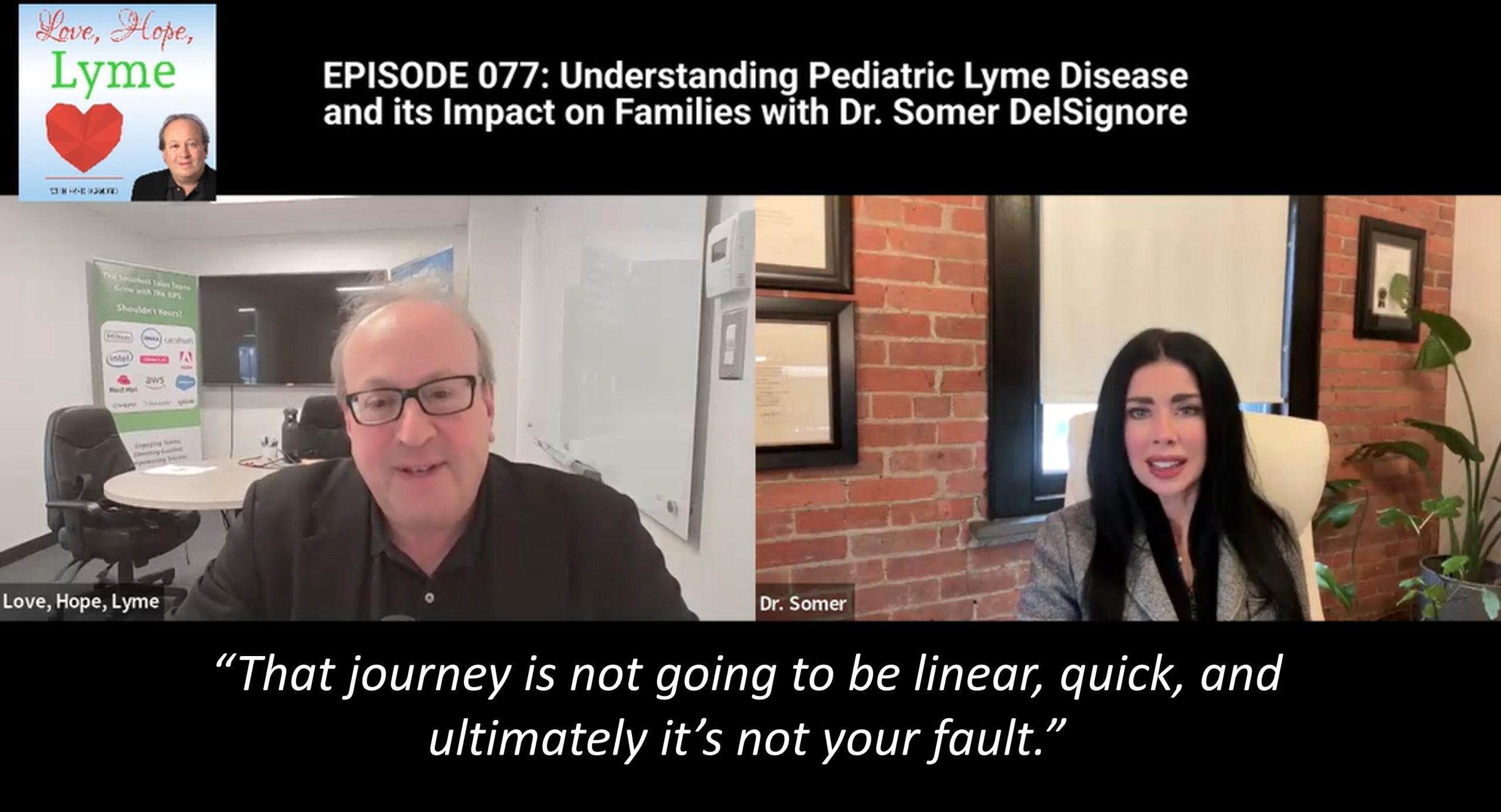
This week’s episode of the Love, Hope, Lyme podcast features Dr. Somer DelSignore, founder of Hudson Valley Integrative Health and a member of the International Lyme and Associated Diseases Society (ILADS).
She discusses what parents can expect when a child is diagnosed with Lyme disease. She also offers suggestions on how to handle the ups and downs that will occur.
Her work focuses on autoimmune and psychiatric manifestations of infectious diseases, particularly tick-borne illnesses in children and adolescents.
The diagnosis no one prepares you for
When a child is diagnosed with Lyme disease, parents often expect a straightforward path: identify the problem, treat it, and move on.
Dr. Somer gently dismantles that expectation.
“The journey is not going to be linear. It’s not going to be quick. And ultimately, it’s not your fault.”
That message alone can be transformative.
I’ve spoken with dozens of parents who carry guilt about having a child with Lyme and associated diseases. They question whether they missed early signs. They wonder if they trusted the wrong doctor. They replay every decision.
But chronic Lyme disease is frequently missed in its early stages. The medical system is structured to detect acute illness, not covert or chronic infections that fragment symptoms across systems.
By the time many families reach Dr. Somer’s office, they may have already seen 10 to 20 providers. They arrive with binders full of labs, scans, and notes. They are exhausted. They are often traumatized.
And they are looking for someone to believe them.
Congenital Lyme and the invisible beginning
One of the most heartbreaking realities Dr. Somer said she sees is congenital exposure. She treats infants who were exposed in utero, often without the mother knowing she had Lyme disease.
In these cases, the baby may not present with classic symptoms. There is no complaint of joint pain or fatigue. Instead, there may be failure to thrive, developmental delays, or unexplained neurological signs.
When testing reveals possible tick-borne exposure passed from mother to child, the guilt can be overwhelming.
“How would you have known?” Dr. Somer tells mothers. “If no one was testing you before or during pregnancy, how could you possibly have known?”
Half of the mothers in these cases had no idea they were infected. The other half were told they had been treated and were “fine.”
In pediatric Lyme, medical care might need to be paired with counseling. Resetting expectations. Removing guilt. Creating a path forward.
The grief of the “before” and “after” child
One of the most powerful parts of our conversation centered on grief.
Chronic illness does not just take health. It fractures identity. It alters timelines. It disrupts imagined futures.
Dr. Somer talks about the “before” self and the “after” self. Parents may grieve the child who once thrived effortlessly. Teens grieve the version of themselves who could go to school all day, play sports, and socialize without consequence.
Children miss school. They lose friendships. They fall behind academically. Some are homeschooled or homebound.
Healing requires acknowledging this grief.
“Hope does not mean pretending nothing has changed. Hope coexists with realism. Stability may become the goal, not perfection. A “small win” may mean concentrating through one class or skipping a midday nap,” she said.
In chronic illness, those small wins can matter.
The caregiver–patient misalignment
Lyme disease introduces tension into even healthy families.
Patients want to be believed without constantly proving they are sick, especially when they “look fine.” They want autonomy. They want space to have bad days.
Caregivers, often parents, want signs that treatment is working. They are terrified it won’t end. They question whether they have the stamina to endure the journey.
Dr. Somer explains that this misalignment can quietly damage relationships.
Teenagers add another layer. Adolescence is already a time of neurological development and emotional volatility. Add neuroimmune dysfunction and fluctuating symptoms, and the nervous systems of both parent and teen can feel constantly triggered.
Dr. Somer recommends structured communication: weekly check-ins, scripts that focus not just on symptoms but on how the caregiver–patient relationship is functioning. Acknowledging what helped even if just a little.
Without alignment, resentment builds. With intention, families can strengthen their bond.
Gaslighting and medical trauma
Perhaps the most painful theme in pediatric Lyme is gaslighting.
Many families describe emergency room visits where children are labeled psychiatric. Some face forced hospitalizations. Others are told symptoms are behavioral or the result of poor parenting.
By the time they reach Dr. Somer, trust in the medical system is often shattered.
“I believe you,” she tells them.
Even then, it can take multiple visits for families to lower their guard. PTSD from medical encounters is real. When you have been dismissed repeatedly, safety does not return overnight.
Dr. Somer relies not only on lab data, but on deep medical history gathering and the art of medicine by connecting patterns, listening closely, and meeting families where they are.
Belief becomes the foundation for rebuilding trust.
School as the second battlefield
For many families, school becomes the next challenge.
Symptoms fluctuate. A child may perform well for one week and struggle with brain fog or fatigue the next. Schools may interpret inconsistency as laziness or behavioral issues.
Dr. Somer encourages starting with 504 plans before escalating to IEPs. Clear medical documentation should explain the episodic and neuroimmune nature of symptoms.
Common accommodations include:
- Shortened school days
- Extra time for testing
- Home tutoring when absences exceed several days
- Focus on core classes during flare periods
- Sensory breaks instead of isolation
The goal is not special treatment. It is dignity and continuity.
Educating family and community
Outside the home and school, another challenge emerges: misunderstanding.
Dr. Somer is clear: you do not owe anyone a simplified version of a complex illness.
“You can set boundaries by saying we’re following a medical plan. Unsolicited advice isn’t helpful right now.”
Not everyone will understand. And that is okay.
When I asked Dr. Somer about hope, her answer was grounded and practical.
“Hope is not toxic positivity. Improvements do not automatically equal cure,” she replied. “We don’t measure hope by how normal our life looks,” she said. “We measure it by how safe we are, how dignified, and how well we connect.”
Caregiver burnout and letting go of the myth
For parents, burnout is real.
The narrative of “get sick, get treated, get better” does not always apply. Clinging to that expectation can deepen despair.
Dr. Somer encourages families to decondition from that script. Accept ambiguity. Accept grieving. Celebrate small wins. Give yourself permission to breathe.
Healing is rarely linear. But resilience is possible. Lyme disease in children can steal time, energy, and milestones. It can fracture identity and strain family systems.
But it does not have to steal connection.
When parents release guilt, align expectations, establish boundaries, advocate in schools, and redefine hope, they create conditions for resilience even amid uncertainty.
“Keep that faith. Keep that hope. And be very realistic with yourself,” Dr. Somer said.
Click here to listen to all episodes of the Love, Hope, Lyme Podcast or on YouTube.
Fred Diamond is based in Fairfax, Virginia. His popular book, “Love, Hope, Lyme: What Family Members, Partners, and Friends Who Love a Chronic Lyme Survivor Need to Know” is available on Amazon. The e-version (pdf) of the book is always free to Lyme survivors. PM Fred on Facebook or LinkedIn for your copy.





We invite you to comment on our Facebook page.
Visit LymeDisease.org Facebook Page