














PODCAST: The geography of denialism and the “no Lyme here” myth
By Fred Diamond
Unfortunately, people suffering from the mysterious, lingering symptoms of Lyme disease have probably heard a familiar refrain from their medical practitioners: “You can’t have Lyme disease. We don’t have Lyme here.”
The here could be North Carolina, Texas, Southern California, or anywhere you can fill in the blank.
Those words have delayed diagnoses, prolonged suffering, and silenced patients who knew something was wrong.
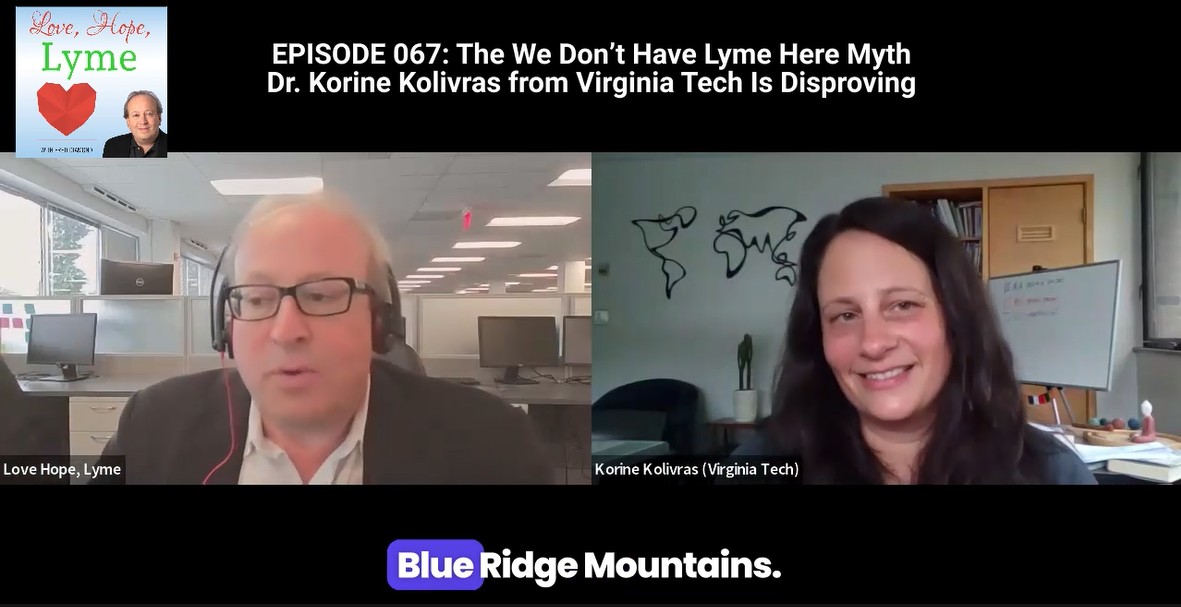
Dr. Korine Kolivras, a geography professor at Virginia Tech, has spent nearly two decades mapping how and why Lyme disease spreads. Her work proves what countless patients already know. That the spread of tick-borne diseases such as Lyme is widespread, even in places where official maps suggest otherwise.
We discussed her research on this week’s Love, Hope, Lyme podcast.
Understanding How Lyme Really Spreads
Kolivras describes herself as a health or medical geographer, which is someone who studies how diseases move through space and time.
“The movement of diseases,” she explains, “is really the movement of people and animals. When we see diseases popping up in new places, it’s usually because people, or the creatures carrying the pathogens, have moved.”
Her research shows that the expansion of Lyme is both ecological and human-driven. Shifts in land use, development, and even bird migration have allowed ticks infected with Borrelia burgdorferi to travel far beyond their traditional range.
“Lyme disease is the most significant vector-borne disease in the U.S., yet its reach is still underestimated,” she says.
The Limits of Official Data
Most of Kolivras’s studies use reported human Lyme cases, which is the numbers doctors submit to state health departments. But she stresses that those numbers only reveal “the edge of Lyme’s true distribution.”
“I constantly hear from people in Georgia, Texas, and Kentucky who tell me their children were sick for years before someone finally said, ‘This looks like Lyme,’” she says. “Those stories confirm what we know scientifically. The real range of Lyme disease extends far beyond what’s been reported.”
In other words, if the data suggest Lyme is confined to the Northeast, the data are wrong. They reflect where doctors are testing, not necessarily where Lyme exists.
Why Geography Matters
In the mid-2000s, Kolivras and her team began noticing a surge of Lyme cases in Virginia, particularly outside of major urban areas like Richmond and Northern Virginia.
“Suddenly, we were seeing high numbers in rural counties,” she recalls. “That made people take notice. Something was happening in the landscape.”
Drawing from earlier studies in New York and Connecticut, she examined how land cover—the mix of forest, grassland, farms, and housing—correlates with Lyme risk. The findings were strikingly consistent.
“Areas with small patches of forest next to open herbaceous cover, like pastures or lawns, had the highest risk,” she says. “That edge habitat is perfect for mice, deer, and ticks. When you fragment large forests into small ones, you actually increase tick-human interaction.”
Their conclusion was that human development patterns create Lyme habitats. Each time a forest is cut into parcels for housing or farmland, the balance between predators and small mammals changes and the tick population flourishes.
Birds, Deer, and the Long-Distance Problem
Kolivras’ more recent work explores how Lyme continues to move south and west.
“Ticks attach to migratory birds. Those birds can carry them hundreds of miles, which helps explain why Lyme appears in new places so quickly.”
Also, deer play a role, though not in the way many assume. “Deer help move ticks to new areas. Combined with bird migration, that creates the perfect recipe for expansion.”
The result is a slow but steady spread of Lyme into regions once considered immune, including the Appalachian corridor stretching from Pennsylvania to northern Georgia.
Kolivras contributed a chapter titled “The Continued Emergence of Lyme Disease in Appalachia” to the new book Appalachian Epidemics: From Smallpox to COVID (University of Kentucky Press).
In it, she proposes a provocative hypothesis that resource extraction from mining, logging, and natural-gas development may be accelerating the emergence of Lyme in the region.
“Appalachia has a long history of extraction,” she explains. “Removing timber and mountaintop mining changes the land dramatically. We lose tree cover and disrupt animal habitats. Those changes might be setting up the perfect environment for ticks to thrive.”
Unlike the suburban expansion that drove the rise of Lyme in New England, Appalachia’s challenge may come from industrial land disturbance rather than residential growth. Kolivras and her graduate students are now testing that theory with new geographic models that link land-use change to disease emergence.
Expanding to the South and West
Maps from the Centers for Disease Control and Prevention (CDC) show Lyme’s progression into Ohio, West Virginia, and the Carolinas, but Kolivras says those visuals still underestimate reality.
“We’ve absolutely seen Lyme move west and south over the past two decades,” she says. “But the official maps are only as good as the diagnoses feeding into them. They don’t include the many people who were misdiagnosed or never tested.”
That underreporting keeps patients invisible and reinforces the false sense that Lyme “doesn’t exist” in their region.
Kolivras also challenges the assumption that Lyme prevention is solely an individual responsibility.
“We always hear, ‘Wear long sleeves. Check for ticks.’ But when it’s 90 degrees and humid, that’s not realistic,” she says. “Prevention should start at the community and policy level with how we design our landscapes.”
Urban sprawl, fragmented forests, and unchecked land clearing all set the stage for Lyme to thrive. “These are collective decisions,” she emphasizes, “not individual failures.”
Her message is particularly relevant as cities expand deeper into formerly wooded or rural areas. Each planning decision such as whether to cut a tree line or preserve a corridor can influence local disease risk for decades.
Lessons from the Dogs
One of Kolivras’ most intriguing insights came from her veterinarian.
“When I first moved to southwest Virginia around 2004, I asked my vet whether Lyme was a concern here,” she recalls. “He said, ‘The human doctors don’t think it’s here, but we vets know. We see it in dogs all the time.’”
That conversation sparked a question: could veterinary data serve as an early warning system for human cases?
“If we see Lyme disease showing up in dogs, that could be the canary in the coal mine,” she says. “It may tell us where human infections are coming next.”
She hopes to integrate that approach into future research by bridging veterinary and human medicine to track emerging hot spots more accurately.
Education is the Key
After 18 years of studying Lyme’s patterns, Kolivras says her greatest wish is better education for healthcare providers.
“We can’t wait for maps to tell us where Lyme exists,” she says. “Doctors and nurses need to ask every patient, ‘Where have you traveled recently?’ Even if the patient hasn’t left town, Lyme should still be considered as a diagnosis.”
She calls this the ‘chicken-or-egg’ problem of Lyme reporting. Until doctors look for the disease, cases won’t be counted. And until cases are counted, doctors assume the disease isn’t present.
Breaking that cycle starts with awareness and with research like hers that shines a light on the reality of Lyme’s reach.
A Researcher Driven by Humanity
While Kolivras’ work is deeply analytical, her motivation is personal and empathetic.
“I love hearing from people affected by Lyme,” she says. “It drives me to keep going. If my research can help even one person feel seen or get diagnosed faster, it’s worth it.”
That humility, coupled with scientific rigor, makes her a vital ally for the Lyme community. Her ongoing projects at Virginia Tech are helping reshape how the medical world, and the public, understands tick-borne disease.
As Love, Hope, Lyme listeners know, progress in Lyme research often feels slow. But scientists like Dr. Korine Kolivras remind us that progress is happening.
Every map revised, every assumption challenged, and every doctor educated brings us closer to a future where no patient hears, “We don’t have Lyme here.”
Click here to listen to all episodes of the Love, Hope, Lyme Podcast or on YouTube.
Fred Diamond is based in Fairfax, Virginia. His popular book, “Love, Hope, Lyme: What Family Members, Partners, and Friends Who Love a Chronic Lyme Survivor Need to Know” is available on Amazon. The e-version (pdf) of the book is always free to Lyme survivors. PM Fred on Facebook or LinkedIn for your copy.






We invite you to comment on our Facebook page.
Visit LymeDisease.org Facebook Page