















A mom’s guide to keeping kids safe from ticks this summer

By Terri McCormick
As parents, we think about sunscreen, bike helmets, and life jackets, but one summer risk many families overlook is ticks.
With camps, sports, and backyard adventures filling the warmer months, children spend plenty of time outdoors. In fact, children are among the groups most likely to be bitten by ticks because of the amount of time they spend playing outside.
Fortunately, experts say a few simple precautions can help reduce tick exposure and keep kids safer all summer long.
One of the best ways to protect children is to make the yard itself less attractive to ticks. Here are ways to create a tick-safe backyard:
Choose the right location for play areas
Place swing sets, sandboxes, trampolines, and patios in sunny areas away from wooded edges and dense vegetation. Experts also recommend creating a three-foot barrier of wood chips, gravel, or mulch between wooded areas and places where children play. These barriers help discourage ticks from moving into recreational spaces.
Remove tick-friendly habitat
Simple landscaping changes can significantly reduce tick activity.
- Mow the lawn regularly and remove leaf litter.
- Clear tall grass and brush around the home.
- Stack firewood neatly in a dry area away from the house.
- Remove brush piles and other rodent friendly hiding spots.
- Trim trees and shrubs to let more sunlight reach the ground.
- Use native plants and avoid dense, moisture holding invasive species.
- Place bird feeders away from play areas to reduce wildlife that may carry ticks.
Plants and landscaping choices
Certain plants and landscape features create the cool, humid environments ticks prefer. Consider avoiding or minimizing:
- Japanese barberry
- Dense groundcovers such as pachysandra
- Leaf litter
- Brush piles
- Tall grasses
- Wood piles near the home
- Shady woodland edges
No plant can eliminate ticks. However, some plants and fragrances may help make yards less attractive to ticks and the animals that carry them.
Plants often mentioned for helping to keep ticks away include:
- Lavender
- Rosemary
- Sage
- Marigolds
- Chrysanthemums
- Geraniums
- Mint
- Lemongrass
Pack a summer tick kit

Casey Kelley, MD ABoIM
Dr. Casey Kelley, founder of Case Integrative Health in Chicago and a mom herself, recently shared what is in her daughter’s summer camp tick kit. While she assembled these items for camp, they can be useful for any outdoor activity, including sports, hiking, and backyard play.
Her recommendations include:
- Permethrin spray for clothing and gear
- Picaridin spray for exposed skin
- An ultrasonic tick repeller that clips onto shoes. (This chemical-free device emits ultrasonic pulses that keeps ticks away.)
- Tick-repellent stickers
- A Tick Twister for proper tick removal
- A Tick Mitt for quick daily tick checks
Parents can find more of Dr. Kelley’s prevention tips on Instagram, where she regularly shares educational videos and practical advice.
Dress for tick season
Simple clothing choices can also help reduce exposure:
- Wear light-colored clothing so ticks are easier to spot.
- Choose closed-toe shoes and long white socks.
- Treat clothing and gear with permethrin. (Don’t apply directly to the skin.)
- Place outdoor clothing in the dryer on high heat after coming indoors to kill any ticks that may be hiding in the fabric.
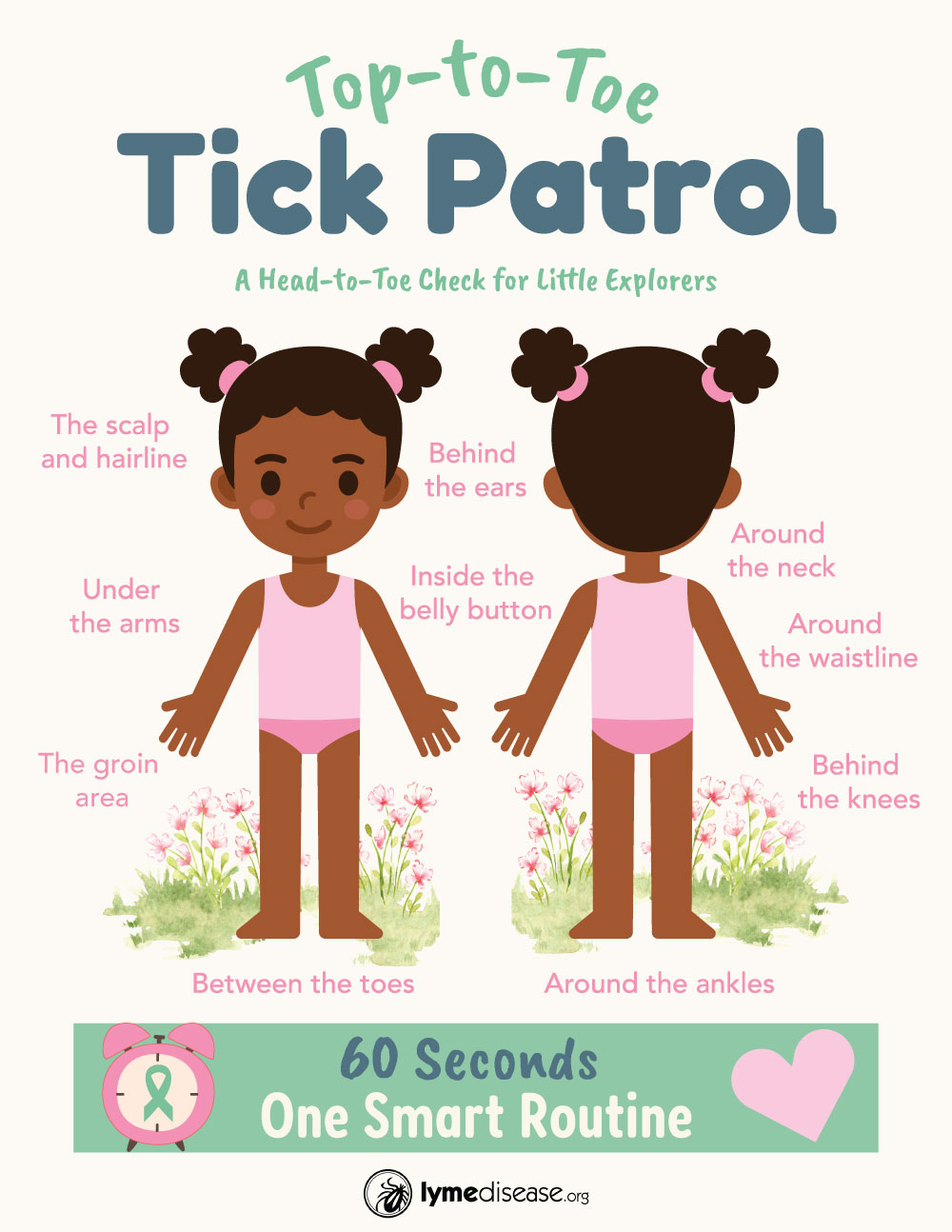
Make tick checks part of the daily routine
(Click to enlarge image.)
One of the most important things parents can do is perform a daily tick check.
Ticks often hide in warm, hard-to-see areas, including:
- The scalp and hairline
- Behind the ears
- Around the neck
- Under the arms
- Inside the belly button
- Around the waistline
- The groin area
- Behind the knees
- Between the toes
- Around the ankles

A Tick Mitt is a glove‑like mitt made from a rough, textured microfiber material that grabs onto ticks before they can attach to your skin. You swipe it over clothing, shoes, pets, gear, and your lower legs after walking through brush.
The texture pulls off ticks that are crawling but haven’t bitten yet.
A Tick Mitt can make tick checks quicker and easier for both children and pets. However, it does not replace a thorough visual tick check.
.
.
If you find a tick, don’t panic
Finding a tick can be unsettling, but prompt removal is important.
 The CDC offers a 60-second instructional video demonstrating the proper way to remove a tick using fine-tipped tweezers titled, How to Remove a Tick.
I pull up the video anytime I remove a tick because it’s reassuring to know I’m doing it correctly.
.
After removing the tick:
- Clean the area with soap and water.
- Save the tick for testing, if possible.
- Never crush a tick with your fingers.
- Watch for a rash or other symptoms in the days and weeks that follow.
- If symptoms develop, seek medical advice from a Lyme-literate healthcare provider.
- Remember that early lab tests may not detect infection. Treatment decisions should be based on symptoms and clinical evaluation, consistent with guidelines from the International Lyme and Associated Diseases Society (ILADS).
Enjoy summer safely
Summer memories should be made around campfires, bike rides, swimming pools, and backyard adventures, not tick bites.
While no strategy can eliminate every risk, a few simple precautions can go a long way toward helping children enjoy the outdoors more safely. By creating a tick-smart backyard, using repellents appropriately, and making daily tick checks part of the routine, parents can help protect their families while still embracing everything summer has to offer.
Terri McCormick is a writer and advocate with LymeDisease.org. She is the author of Being Misdiagnosed: Stories That Reveal the Hidden Epidemic of Lyme Disease. The book is available on Amazon and at BeingMisdiagnosed.com.
Sources
Case Integrative Health. “Case Integrative Health.” Instagram. Accessed June 3, 2026. https://www.instagram.com/caseintegrativehealth/.
Centers for Disease Control and Prevention. “How to Remove a Tick.” YouTube video, 1:05. Accessed June 3, 2026. https://www.youtube.com/watch?v=S4Ny5YJh6Ws..
Connecticut Agricultural Experiment Station. Tick Management Handbook: An Integrated Guide for Homeowners, Pest Control Operators, and Public Health Officials for the Prevention of Tick-Associated Disease. Bulletin No. 1010. New Haven, CT: Connecticut Agricultural Experiment Station, 2007. Accessed June 3, 2026. https://portal.ct.gov/-/media/caes/documents/publications/bulletins/b1010pdf.pdf.
Cornell Integrated Pest Management. “Managing Ticks in the Landscape.” Cornell University College of Agriculture and Life Sciences. Accessed June 3, 2026. https://cals.cornell.edu/integrated-pest-management/outreach-education/whats-bugging-you/ticks/managing-ticks-landscape
International Lyme and Associated Diseases Society. “Evidence Assessments and Guideline Recommendations in Lyme Disease: The Clinical Management of Known Tick Bites, Erythema Migrans Rashes and Persistent Disease.” Expert Review of Anti-Infective Therapy 12, no. 9 (2014): 1103–1135. Accessed June 3, 2026. https://www.ilads.org/patient-care/ilads-treatment-guidelines/.
University of Maine Cooperative Extension Tick Lab. “Tick Lab Resources.” Accessed June 3, 2026. https://extension.umaine.edu/ticks/.






We invite you to comment on our Facebook page.
Visit LymeDisease.org Facebook Page