












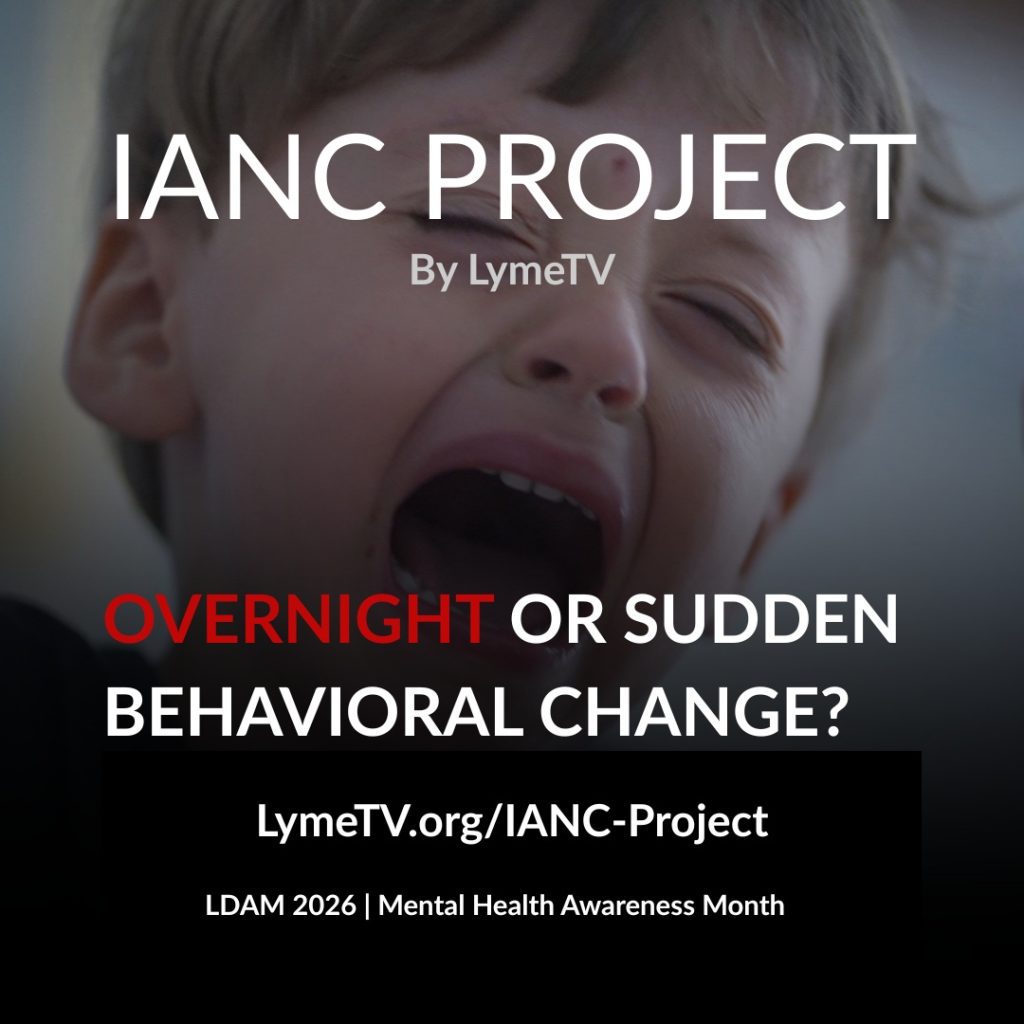
Did your child’s behavior change overnight? LymeTV tackles PANS/PANDAS
By Team LymeTV
Imagine your child goes to sleep one night and wakes up a different person. The vibrant, curious child you knew is suddenly replaced by a stranger struggling with debilitating OCD, terrifying tics, and uncontrollable rage.
For thousands of families in the Lyme community, this is the nightmarish reality known as PANS (pediatric acute-onset neuropsychiatric syndrome) or PANDAS (for those cases triggered by a recent strep infection).
This week, coinciding with Lyme Disease Awareness Month and Mental Health Awareness Month, LymeTV is launching a high-impact television campaign to bring these “Infection Associated Neuropsychiatric Conditions” (IANC) out of the shadows.
Rooted in the patient experience
This campaign is more than just a series of advertisements; it is a mission born from a deep understanding of the patient journey.
“As the founder of LymeTV and a patient myself, I have lived through the isolation of a medical system that too often looks the other way,” says Adina Bercowicz, MPH.
“We built the IANC Project so that no other family has to search in the dark for answers alone. These are real, biologically-driven conditions. Every day we delay research is another day a child loses their childhood to an illness that could be treated — if only we understood it better.”
Strategic visibility in the nation’s power corridor
While the campaign is hitting the “big screens” on major networks including CNN, ESPN, and CNBC, the placement is highly strategic. The PSAs are geo-targeted to the DMV area (DC, Maryland, and Virginia).
By saturating the airwaves in the nation’s power corridor, LymeTV is ensuring this message reaches the doorsteps of federal health agencies, national policymakers, and influential physicians who have the power to shift the clinical paradigm.
The spots educate viewers on how common infections like strep or vector-borne illnesses (Lyme & Bartonella) can trigger an autoimmune response that attacks healthy brain tissue.
By scanning an on-screen QR code, viewers are directed to a dedicated resource page featuring peer-reviewed research, including the landmark Fallon 2021 study, providing foundational evidence for the link between Lyme infection and neuropsychiatric symptoms.
A global scientific and advocacy alliance
The campaign is part of a coordinated effort for clinical recognition. LymeTV is proud to highlight the aligned advocacy of the Center for Lyme Action (CLA) and the National Alliance for PANS/PANDAS Action (NAPPA), who are currently working to secure federal recognition and research funding.
The IANC Project has been previewed and supported by leading researchers at the Pathobiome Research Center.
“The Pathobiome Research Center at PCOM is dedicated to uncovering the microbial mechanisms that drive conditions like PANS & PANDAS,” says Nikki Schultek, Founding Director of the Pathobiome Research Center.
“Campaigns like LymeTV are critical to building the public and political will needed to fund that research. When a child’s personality changes overnight, families deserve answers—and science is beginning to provide them.”
How you can help: watch and share
The fight for clinical recognition and federal research funding at the NIH & CDC requires a collective voice. We are calling on the Lyme community to help us turn this awareness into a movement.
Please watch the campaign videos and share them with your school boards, your pediatricians, and your social networks. Every share helps a parent recognize the symptoms of IANC before another year of misdiagnosis passes.
LymeTV is a nonprofit organization dedicated to preventing tick‑borne diseases through education and awareness.





We invite you to comment on our Facebook page.
Visit LymeDisease.org Facebook Page