











PODCAST: What Lyme disease really demands

By Fred Diamond
I’ve spoken with thousands of Lyme survivors, and many use the word resilient to discuss their healing journey. This week’s Love, Hope, Lyme podcast guest Nicole O’Donnell doesn’t just offer a formula for healing.
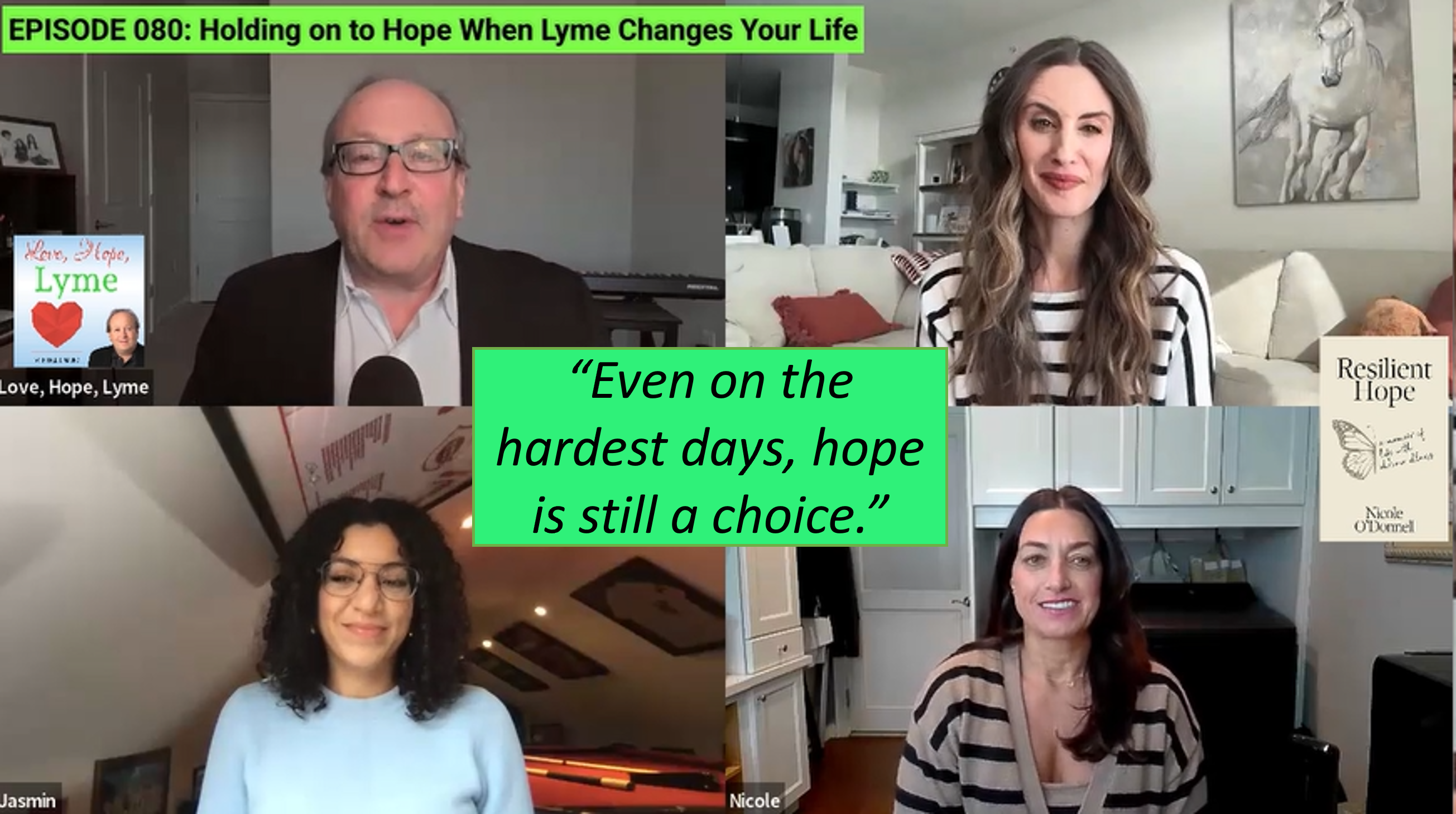
Instead, she offers something far more meaningful to Lyme patients: a clear, honest, yet often challenging picture of what resilience requires. She appeared on the show with two members from her Lyme healing community: Christa Nannos and Jasmin Perdomo.
Her story, drawn from her memoir Resilient Hope, is not about overcoming Lyme disease in a straight line. It is about learning how to endure it, adapt to it, and rebuild a life within it. Her journey is not abstract. It is detailed, specific, and deeply lived.
She remembers the treatments, the setbacks, the emotional turning points. Some of that comes from journaling, and much of it comes from what her body has carried: experiences that were once pushed aside but eventually resurfaced. And that resurfacing is not incidental. It is part of the process.
Nicole says Lyme disease forces a confrontation with everything that has been left unresolved. Resilience, in this context, is not about pushing forward blindly. It is about being willing to face what emerges, even when it is uncomfortable.
“Unless You Live This, You Cannot Understand It”
One of the first ways Nicole builds resilience is by recognizing her limits and the limits of others, including many people very close to her.“The main thing is that unless you live this, you truly cannot understand it,” she says.
She wants her family to fully understand what she is experiencing. She wants them to feel it, to validate it in a way that matches her reality. Eventually, she accepts that they cannot, at least not completely. That realization is painful, but it is also freeing.
Instead of trying to explain the unexplainable, she begins to seek out people who already understand. That decision leads her into the Lyme community, where shared experience replaces explanation. Through that process, she forms connections with people like Jasmin and Christa and reinforces what she has learned.
Jasmin describes Nicole in simple but powerful terms: “She truly was my lifeline.”
Resilience, Nicole discovers, is not built in isolation. It is strengthened through connection.
Redefining Progress
One of the most difficult lessons Nicole learns is that healing does not follow a predictable path. There are moments when she feels stronger, more stable and closer to herself again. Then, without warning, symptoms return.
And at first, those setbacks feel like failure, but over time, she reframes them. This shift is essential, because Lyme disease creates not only physical instability, but psychological tension. Each symptom carries the potential to trigger fear of regression, fear of losing progress.
“A setback doesn’t mean I’m going back to my worst days,” she explains.
Nicole names what many patients quietly carry: “I think most of us experience a lot of PTSD.”
Resilience, in this context, means continuing forward without requiring certainty. It means accepting fluctuation without assuming collapse.
Letting go of the search for a cure
Like many patients, Nicole initially searches for the one treatment that will resolve everything. She listens to others. She considers new protocols. She wonders if the next step will finally be the one that works, but eventually, she confronts a difficult truth that changes everything.
“There wasn’t a magic pill,” she says.
It shifts her from waiting for healing to actively participating in it.
Christa, who also supports other Lyme patients, reinforces this perspective. The illness is rarely simple. “It’s never just Lyme,” she explains, pointing to the multiple layers of co-infections, environmental exposures, and systemic stress that often shape the condition.
For Nicole, resilience becomes the ability to navigate that complexity without becoming consumed by it.
Learning to work with your body, not against it
Perhaps the most significant shift in Nicole’s journey is how she relates to her own body.
At first, she resists it. She wants to maintain her previous pace, her previous identity. She wants to push through the limitations. But her body forces her to stop. Gradually, her perspective changes.
“My body wasn’t betraying me,” she says. “It was communicating.”
This realization requires a different kind of strength. Instead of forcing progress, she begins to listen. Instead of criticizing herself, she practices compassion. For high-achieving individuals, slowing down without losing a sense of self is often one of the hardest aspects of resilience.
“I had to learn to just have compassion for myself,” she adds.
Resilience requires facing loss
As Nicole continues her journey, she is forced to confront another dimension of resilience: grief. Memories from her past resurface, including difficult experiences tied to her father. At the same time, she is grieving the loss of who she once was, and this is on-going.
Jasmin describes a similar experience, mourning both a long-term relationship and her former identity.
For Nicole, resilience is not about avoiding that grief but about allowing it. Healing requires acknowledging what has changed, what has been lost, and what may not return.
Finding gratitude without denying reality
Despite everything she has experienced, Nicole arrives at a place she once thought impossible: gratitude.
“I’m grateful for the people that I’ve met along the way,” she says. “I’m grateful that I’m here.”
This gratitude does not erase the hardship. It exists alongside it. It reflects a shift in perspective from focusing only on what has been lost to recognizing what remains. Resilience, in this sense, is not about positivity. It is about balance.
The choice to keep going
At the core of Nicole’s story is a simple but powerful idea: resilience is a choice. Not a one-time decision, but a repeated one. Each day brings uncertainty. Each symptom brings a new challenge. Each setback presents a moment where giving up might feel easier.
“If I didn’t learn to stay hopeful,” she says, “I would not be where I am today.”
Hope is an act of resilience.
Nicole titles her book Resilient Hope for a reason. Hope, as she defines it, is not dependent on outcomes. It is not tied to a specific treatment or timeline.
It is what allows her to keep moving forward even when the path is unclear.
For Lyme patients, that message resonates deeply. Because resilience is not about having answers. It is about continuing without them.
And sometimes, that is the strongest form of hope there is.
Click here to listen to all episodes of the Love, Hope, Lyme Podcast or on YouTube.
Fred Diamond is based in Fairfax, Virginia. His popular book, “Love, Hope, Lyme: What Family Members, Partners, and Friends Who Love a Chronic Lyme Survivor Need to Know” is available on Amazon. The e-version (pdf) of the book is always free to Lyme survivors. PM Fred on Facebook or LinkedIn for your copy.





We invite you to comment on our Facebook page.
Visit LymeDisease.org Facebook Page