













“Just live with it” is not medical care. Lyme pain deserves better.

by Fred Diamond
I have communicated with thousands of Lyme survivors over the past few years. One told me that she asked the nurse practitioner at her LLMD’s office for something to help her deal with the constant pain she was experiencing. The nurse practitioner said, “You’re just going to have to figure out how to tough it out.”
When I heard that story, I made it a point to cover pain management on an episode of the Love, Hope, Lyme podcast. After seeing the reaction to this week’s show, I look forward to discussing this topic more so in the future.
“You just have to learn to live with the pain.” It may be said casually. It may even come from a medical professional. But for people living with Lyme disease, that message can be devastating. It suggests that the pain they experience is inevitable, permanent, and ultimately something they must accept.
That mindset needs to change.
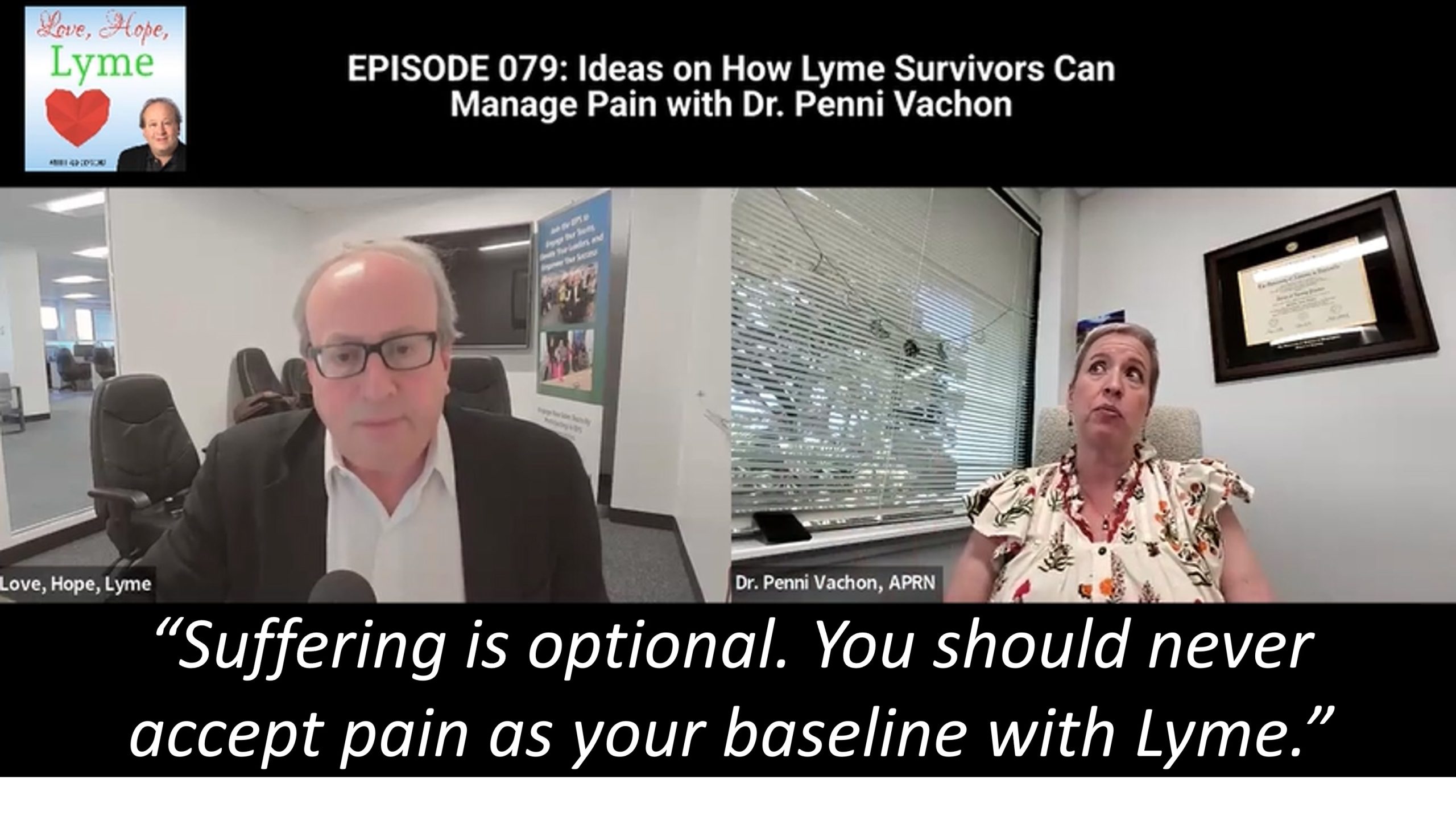
In this week’s Love, Hope, Lyme Podcast, I speak with Dr. Penni Vachon, an integrative nurse practitioner and Lyme survivor who has treated thousands of patients. We focus specifically on pain: how it presents, why it persists, and why so many Lyme patients struggle to get meaningful relief. Her perspective is direct and grounded in both clinical experience and personal understanding.
As she said clearly, “You should not. That should never be an acceptable baseline for anybody. Period. Ever.”
 The nature of Lyme pain
Lyme-related pain does not behave the way most people expect pain to behave. It is not typically tied to a single injury or event, and it does not follow a predictable recovery path. In many cases, patients cannot point to a specific cause, and traditional approaches to pain, including rest, physical therapy, or standard medications, often fail to resolve it.
Instead, Lyme pain presents as something more persistent and less defined. It can show up in joints, muscles, tendons, ligaments, or along nerve pathways. Some patients experience deep joint discomfort that resembles arthritis, while others deal with muscle soreness that feels like chronic overuse. Still others report nerve-related symptoms such as tingling, numbness, or burning sensations that move throughout the body.
What makes this particularly difficult is that the pain is often constant. It is not limited to certain activities or times of day. As Dr. Vachon describes from her own experience and from what she sees in patients, it is “waking pain, sleeping pain, toss-and-turn pain, and it wasn’t driven by activity.”
That consistency is what wears people down. There is no clear trigger to avoid and no reliable way to predict when it will improve. It becomes part of daily life, affecting everything from sleep to concentration to emotional stability.
Why the pain does not resolve
One of the reasons Lyme pain is so persistent is that it is driven by more than one process in the body. According to Dr. Vachon, the pain is the result of both direct damage from pathogens and the body’s own immune response.
The bacteria associated with Lyme and its co-infections release toxins that can affect tissues throughout the body. In response, the immune system attempts to contain and neutralize those toxins, triggering inflammation as part of the defense process. This creates a situation where both the infection and the body’s response to it are contributing to the problem.
As she explains, “Not only are the toxins attacking the tissue, but the body is attacking the toxin. There is an inflammatory cascade that happens with it.”
This ongoing inflammatory state is a key driver of pain. Unlike an injury that heals over time, the underlying causes of Lyme-related inflammation may still be active, which means the pain does not simply resolve on its own. Until those drivers are addressed, patients can remain stuck in a cycle of ongoing discomfort.
The challenge of misdiagnosis
Another major issue Lyme patients face is that their pain is frequently misdiagnosed. Because the symptoms overlap with other conditions, patients are often told they have rheumatoid arthritis, lupus, fibromyalgia, or general “wear and tear” in the joints.
While these diagnoses may seem reasonable based on symptoms alone, they do not always reflect the underlying cause. Dr. Vachon shared an example from her own practice where a patient had been labeled with lupus despite normal markers, only to later find a significant Lyme and co-infection profile.
“I don’t think you have lupus,” she told the patient. “I think you have Lyme that they’re mistaking.”
When patients are misdiagnosed, they are often placed on treatment plans that do not address the root issue. As a result, the pain continues, and patients may begin to feel that nothing will work. This not only delays appropriate care but also contributes to frustration and, in many cases, a loss of confidence in the healthcare system.
The broader impact of chronic pain
Chronic pain affects far more than the physical body. Over time, it begins to impact nearly every aspect of a person’s life. Sleep is often one of the first things to suffer, as patients struggle to find comfortable positions or wake frequently throughout the night. Lack of sleep then contributes to fatigue, reduced cognitive function, and difficulty managing daily responsibilities.
Relationships can also be affected. When someone is in constant pain, their ability to engage socially or maintain consistent energy levels changes. This can lead to misunderstandings with family, friends, and colleagues, particularly when the pain is not visible or easily explained.
There is also an emotional component. Many Lyme patients report feeling dismissed or not fully believed when they describe their symptoms. Managing ongoing pain while also trying to validate that experience to others adds an additional layer of stress that can be difficult to sustain.
Why “just live with it” is harmful
Given all of this, the idea that Lyme patients should simply accept their pain is not only incorrect, but also harmful. It shifts the responsibility away from finding solutions and places it on the patient to endure something that may be treatable.
Dr. Vachon’s response to this mindset is straightforward: “Suffering is optional.”
This does not mean that resolving Lyme pain is easy or immediate. It means that pain should be taken seriously and addressed as part of the overall treatment strategy. Ignoring it or minimizing it does not help patients move forward.
Pain management as a requirement for healing
One of the most important points from our discussion is that pain is not just something to manage it is something that directly affects the body’s ability to heal. When the body is in a constant state of distress, it becomes more difficult to regulate inflammation, balance the nervous system, and support recovery.
Dr. Vachon emphasizes this clearly: “When you are in pain, your body cannot heal. It is a non-negotiable for me.”
This perspective reframes pain management as a core component of treatment rather than a secondary concern. Addressing pain can help stabilize the body and create the conditions needed for deeper healing to occur.
The role of the nervous system
The nervous system also plays a significant role in how pain is experienced. When the body is in a prolonged state of stress, often described as fight, flight, or freeze, pain signals can become amplified. What might otherwise be manageable can feel significantly more intense.
As Dr. Vachon notes, “Pain that may have been a 5 is now a 9 or a 10.”
This is why approaches that help regulate the nervous system can be valuable. Techniques such as controlled breathing, sound-based therapies, or other calming practices may not eliminate the source of the pain, but they can reduce its intensity and improve a patient’s ability to cope with it.
The need for individualized care
Lyme disease does not present the same way in every patient, and pain is no exception. The variability in symptoms, co-infections, immune responses, and overall health means that there is no single approach that works for everyone.
Dr. Vachon summarizes this reality well: “We could take a hundred Lyme patients in a room and they’re going to have a hundred different Lyme presentations and a hundred different Lyme treatments.”
This reinforces the importance of individualized care. Patients need providers who are willing to look beyond standard protocols and adapt treatment strategies based on the specific presentation and needs of each individual.
Moving forward
Lyme-related pain is real, and for many patients, it is one of the most difficult aspects of the disease to manage. It is complex, persistent, and often misunderstood. But it is not something that should be dismissed or accepted as a permanent condition.
Patients deserve to have their pain taken seriously. They deserve providers who are willing to investigate the root causes and explore appropriate treatment options. And they deserve to know that relief is possible, even if it requires time and a personalized approach.
The message that Lyme patients must simply “live with it” does not serve anyone. It delays progress, undermines trust, and leaves patients without the support they need.
Click here to listen to all episodes of the Love, Hope, Lyme Podcast or on YouTube.
Fred Diamond is based in Fairfax, Virginia. His popular book, “Love, Hope, Lyme: What Family Members, Partners, and Friends Who Love a Chronic Lyme Survivor Need to Know” is available on Amazon. The e-version (pdf) of the book is always free to Lyme survivors. PM Fred on Facebook or LinkedIn for your copy.






We invite you to comment on our Facebook page.
Visit LymeDisease.org Facebook Page