







Titanium and tenacity: one woman’s fight for Lyme patients everywhere
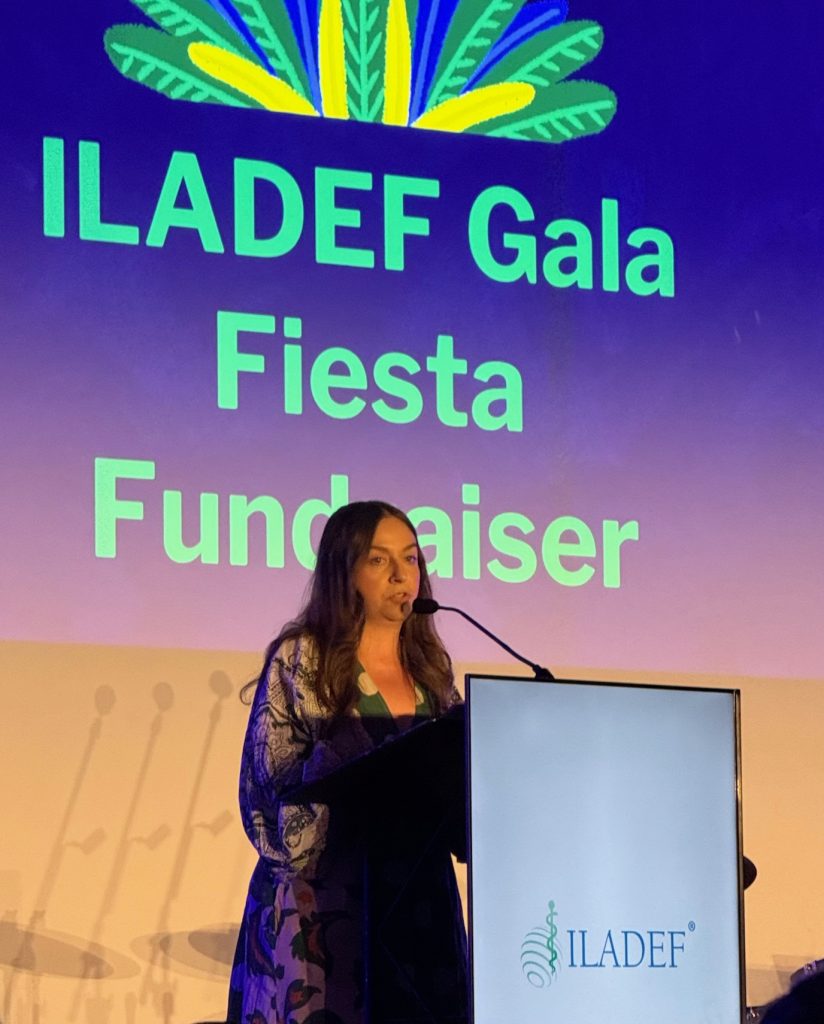
Meghan Bradshaw gave the following speech at a recent fundraising dinner held by the International Lyme and Associated Diseases Educational Foundation. ILADEF is the educational arm of ILADS, focused on training physicians in the diagnosis and treatment of Lyme and other tick-borne diseases.
Good evening. I better look like a million bucks because that’s about what it cost in orthopedic surgeries so I’d be able to stand before you tonight.
It’s truly an honor to be here — among people who have not only studied tick-borne disease but stood with those of us living it.
My name is Meghan Bradshaw, and I serve as the Government Relations Manager at the Center for Lyme Action.
But long before I ever walked the halls of Congress… I was a patient.
From the fast lane to a hospital bed
In 2019, I was living in Nashville, thriving in a career at Nordstrom — mentoring teams, chasing goals, running on caffeine and purpose. I thought I had my life mapped out.
Then a simple knee injury sent me home to North Carolina for what was supposed to be a quick two-to-three-week medical leave to repair a torn meniscus.
Three weeks became three months… and then three months turned into three years.
I went from being a fast-paced leader to being bedridden. From running multi-million dollar businesses and dynamic teams to not being able to lift a fork.
At the prime age of twenty-six, I had bilateral hip replacement surgery — and the very next morning, an email arrived confirming my tick-borne disease diagnosis. Finally, I understood what had been wreaking havoc on my body for years leading up to this.
That diagnosis answered everything and explained nothing all at once.
The steep cost of misdiagnosis
I’d been misdiagnosed for years with an autoimmune disease, treated with immunosuppressants, and by the time we knew the truth, the damage was done.
Since then, I’ve had ten total joint replacements and eight surgical joint fusions.
But I always say: it wasn’t that my infections were so severe—it’s that I was misdiagnosed for years. I was treated with immunosuppressants that accelerated my disease.
My story isn’t rare—it’s simply what happens when people fall through the cracks of a broken system.
Piece by piece, my body was being rebuilt. It became almost a badge of survival, a reminder of how much this disease can take, but also of how much we can overcome
So yes — I’m the bionic woman. But I wouldn’t recommend the path to get here.
For a long time, my world shrank to four walls, surgery recoveries and an IV pole. At my worst, my functional level was comparable to someone with a spinal cord injury and my fine motor skills comparable to those of a toddler. I lost my independence, my confidence, and at times, my will to fight.
I don’t believe that one can know a grief more profound than being trapped in a body that can no longer carry out what your mind and your heart intend to do. I spent hours upon hours every day for months sobbing, grieving the life that I intended for myself. I constantly said, “I can’t do this anymore.”
Rebuilding body and spirit
Somewhere along the line I realized that I needed to master acceptance. I remember thinking to myself “if this is as good as it gets, how am I going to make the most of it?”
When I couldn’t strengthen my body, I decided to strengthen my mind.
I went back to school for my Master’s in Public Health at UNC Chapel Hill and participated in the 2022 HHS Federal Tick-Borne Disease Working Group.
I learned about systems, policy, and how change actually happens. I was joining advocacy meetings from my hospital bed — as you can imagine, my pain regimen made me quite the lively participant in these meetings.
And although my body was being rebuilt with cobalt, steel and titanium, my spirit was hanging by a thread.
After about a month in the hospital following complications from bilateral knee replacements, I returned home. It was on that drive that I realized so much time had passed while I was sitting still. I was deeply traumatized and severely depressed.
When my cries went from “I can’t do this anymore” to “I don’t want to do this anymore,” this work became my North Star. It was the reason that I kept going. I needed to see these things through.
It’s hard to convey just how stuck I was. How limited I became. I watched an orchid bloom in real time before my eyes. I watched the trees in my parents’ backyard turn red, become barren, and bloom again in the spring. Three times over.
But during this time I found my way back to the classroom, to Center for Lyme Action — and thankfully, I eventually found my purpose.
Coming full circle
During this time, I also began telling my story. I was honored to have been featured by the organizations that I work with, but also international media platforms like today, WebMD, and even The Daily Mail.
I have been referred to as “one of the worst cases of tick-borne illness”—but that is simply not true. I recognize how fortunate I am to have had the means to improve my condition. That I have the opportunity to live a full and meaningful life. This is why I am passionate about working towards a world in which healthcare is equitable and just—because everyone deserves that opportunity.
Now, here’s where the story comes full circle.
For years, I traveled to Washington, D.C. for medical treatment with my ILADS doctor — desperate for answers, for a little hope, for a sign that life could ever look normal again.
Today, my trips to Washington look very different. I no longer go for treatments. Now, I go to walk the halls of Congress. I sit across from senators and representatives—not as a patient asking for help, but as an advocate demanding action.
At the Center for Lyme Action, I help lead government relations and advocacy for a network of more than 10,000 advocates across all 50 states, D.C., and Puerto Rico — a community made up of patients, families, scientists, and physicians who’ve all turned their pain into purpose. They remind me that this fight is not about statistics, not about abstract policy—it’s about restoring futures.
Together, we are doing something remarkable.
Finding purpose in policy
Since the founding of the Center for Lyme Action in 2019, we’ve helped grow federal funding for Lyme and tick-borne diseases by more than half a billion dollars.
Half. A. Billion.
That’s not just numbers on paper — that’s research grants awarded, prevention programs expanded, and real hope for families who’ve been fighting in the dark.
And yet… we know this is still just the beginning.
This week we observed World Mental Health Day and PANS/PANDAS Awareness Day. And tonight, I’m especially proud to share that we are launching a new Center for Lyme Action initiative focused on infection-associated neuropsychiatric conditions — including Lyme disease, Bartonella, and PANS/PANDAS.
This initiative will unite researchers, clinicians, and policymakers to confront how infections can trigger profound neurological and psychiatric symptoms — and to ensure that patients are seen, treated, and believed across disciplines.
Because too many people are suffering in silence — caught between infectious disease and mental health systems that don’t yet speak the same language.
We can — and we must — change that.
Healing, redefined
One of the greatest lessons I’ve learned is that healing doesn’t always mean being cured. Sometimes, healing means reclaiming a little bit of what’s been taken from us.
I’ve seen what happens when science meets storytelling, when data meets determination, when doctors and patients walk the same road together.
That’s where real progress lives — in partnership.
Our fight is far from over. We need sustained federal investment that matches the human toll of these diseases. We need you to join us in this fight. Every one of us in this room holds a piece of the solution — and together, we are going to be unstoppable.
I used to think my illness had taken everything from me. But now I see that it also gave me something — clarity.
Clarity about what matters. Clarity about who I am. And clarity about why I’m still here: to help make sure no one else loses years, livelihoods or lives to these insidious diseases.
That’s my “why.”
So, from one titanium-filled advocate to a room full of heroes — thank you. Thank you for your research, your compassion, and your refusal to give up on patients like me.
Because when we show up together—in clinics and in the halls of Congress—we’re not just changing policy. We’re changing lives.
The day will come when “tick-borne disease” no longer means tragedy, but triumph. And when that day arrives — we’ll know it was because of all of you.
Fortunately or unfortunately, I am running out of body parts to donate to help move the cause forward, so I am humbly asking for your help. And no, you don’t have to donate a body part—money will do.
Thank you — for helping me, and so many others in this fight, take this stand.
Click here to learn more about the Center for Lyme Action.





We invite you to comment on our Facebook page.
Visit LymeDisease.org Facebook Page