






PODCAST: National Academies report opens a new chapter in Lyme research
By Fred Diamond
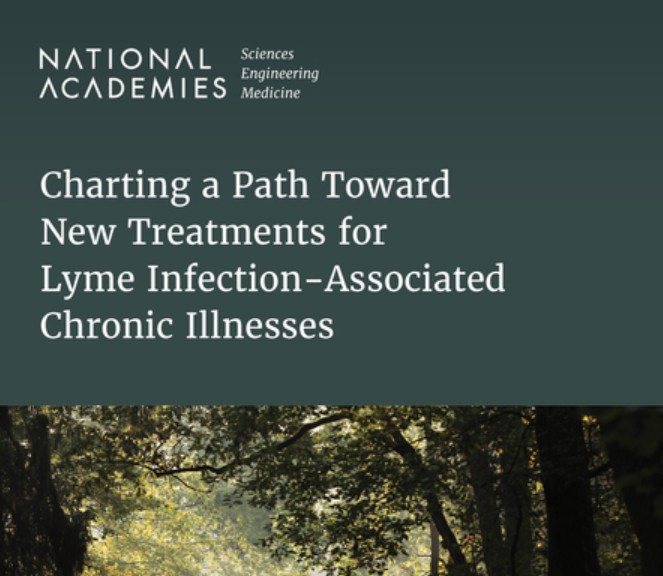
Lyme awareness got a major boost recently with the publication of the new National Academies of Sciences, Engineering, and Medicine (NASEM) report “Charting a Path Toward New Treatments for Lyme Infection-Associated Chronic Illnesses.”
Lyme survivors, their families, and advocates have been calling for governmental recognition and solutions for decades, and the August 2025 report represents a turning point. For the first time, the United States’ collective scientific voice has declared that what patients have long described, that ongoing, debilitating symptoms after standard treatment for Lyme disease, is real.
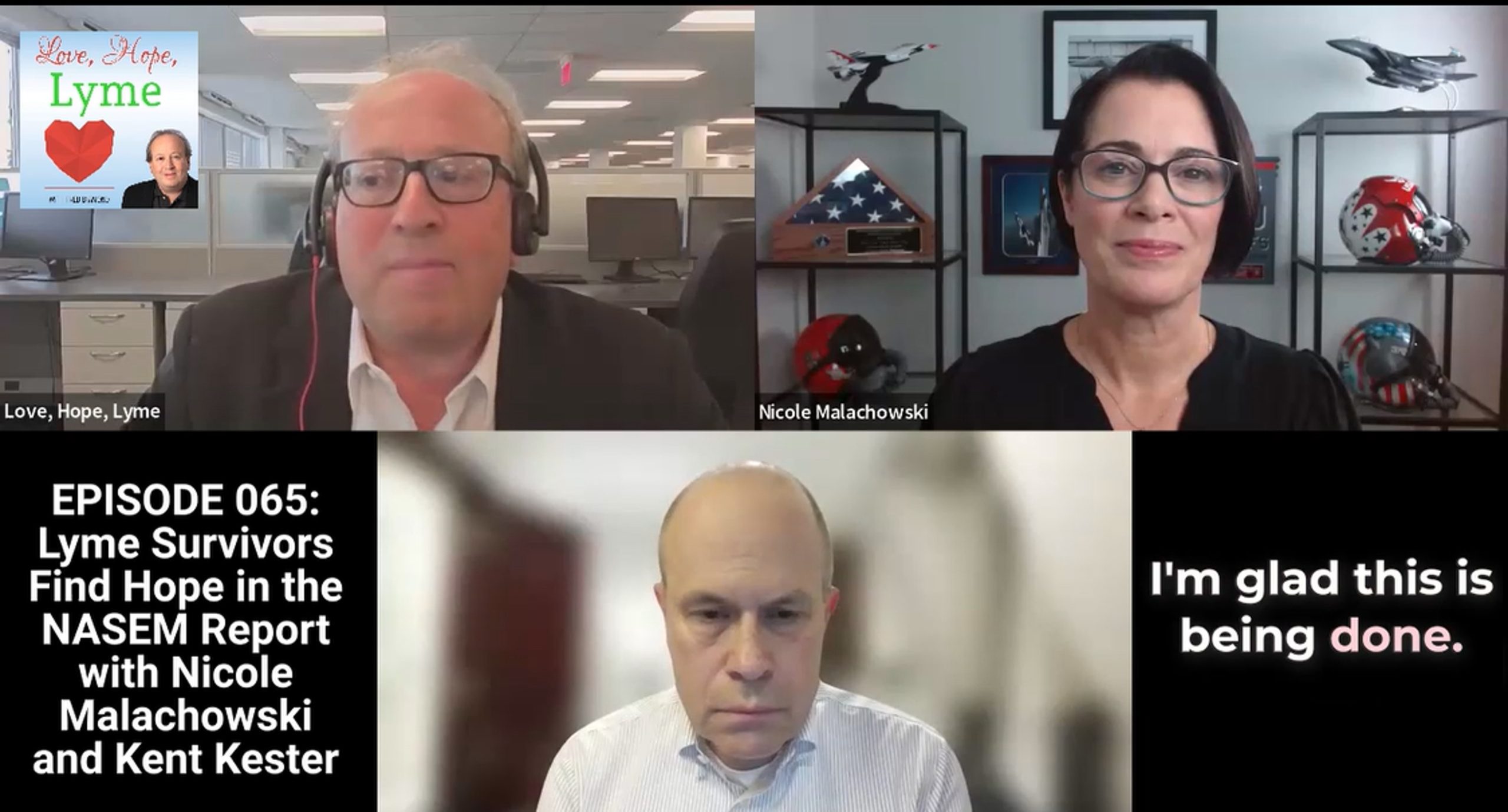
On this week’s Love, Hope, Lyme podcast, two of the authors of the report, retired Air Force Colonel and Lyme advocate Nicole Malachowski and infectious disease physician and research leader Dr. Kent Kester, shed light not only on the significance of the report but also on the road ahead.
From Fighter Pilot to Patient Advocate
Nicole Malachowski’s life is a story of both triumph and disruption. She served more than 21 years as a fighter pilot in the United States Air Force, breaking barriers as the first woman to fly with the Thunderbirds. But a tick bite abruptly ended her military career, leaving her with complex, chronic symptoms.
“I’m one of the people that 20% who get Lyme disease, get treatment, and then still have complex chronic symptoms,” she shares. “I was medically retired almost eight years ago, and in these past eight years, I’ve made it my new purpose and my new mission to try to move the ball forward in this space so that what happened to me doesn’t happen to other people.”
That mission has now placed her in a historic role by serving as the patient voice on the NASEM committee that produced this report. For Colonel Malachowski, the experience broadened her scientific understanding while reinforcing the urgency of patient-centered advocacy.
“Being on that committee for a year really expanded my mind scientifically, policy-wise, and everything in between,” she says.
“It’s why I’ve been increasing my educational efforts across social media. Patients need to know what’s happening, and their voices matter.”
What Is NASEM and Why This Report Matters
Dr. Kent Kester, who has spent decades in infectious disease research and now serves as Executive Director of Research and Development at the Coalition for Epidemic Preparedness Innovations (CEPI), helped explain the backdrop.
“The National Academies were chartered over 150 years ago as an independent entity intended to help advise the U.S. government on matters of science,” he notes. “They also serve as a convening role for scientific questions of national and international importance.”
The report grew out of a workshop on the chronic impacts of infectious diseases, particularly in the context of long COVID. The parallels with Lyme disease were striking, and soon after, the Steven & Alexandra Cohen Foundation, the longtime supporters of Lyme research and advocacy, sponsored a full consensus study focused specifically on the chronic impacts of Lyme disease.
Kester emphasizes, “Our focus is always on patients. We want to know the science that will be very helpful in developing therapeutic interventions. But the bottom line of the report is patients are suffering, and we need to do something about it.”
Lyme Infection-Associated Chronic Illnesses (IACI)
One of the most impactful contributions of the report is its terminology. Rather than relying on the polarizing and often misunderstood phrase “chronic Lyme,” which I prominently use in the title of my book, the report introduces Lyme Infection-Associated Chronic Illnesses (IACI).
Malachowski explains, “By using the term IACI, we’re casting the net wide, keeping that umbrella very open to all possibilities. When we use that term chronic Lyme, different stakeholders interpret it differently. By using IACI, we’re hoping to capture all of those perspectives and get us aligned moving forward on finding the reasons and the treatments for this.”
Kester agrees, noting that while “IACI” may not roll off the tongue, it serves a vital purpose: inclusivity.
“We didn’t want to exclude people with just a very narrow focus,” he says. “People are hurting, and to be exclusionary, when we’re really not clear on the outer bounds of what these diagnoses are, didn’t seem to make sense.”
Validating Patient Experience
For years, Lyme survivors have battled not only their symptoms but also skepticism from medical institutions, insurers, and even family and friends. Malachowski believes the NASEM report changes that dynamic.
“NASEM is chartered by Congress. It is the collective scientific voice of the United States of America. For the first time ever, the United States is saying Lyme IACI is real,” she declares. “I want people to feel validated by that. I want them to realize they’re not alone, and I want them to have hope.”
The validation matters because the symptoms are life-altering. As Kester points out, many assume Lyme is only about arthritis, flu-like illness, or the occasional heart complication.
But the reality for IACI patients includes crushing fatigue, chronic pain, neurological dysfunction, and cognitive impairment, all conditions that persist even after the CDC-recommended three weeks of antibiotics.
“Why some people have brain fog, unexplainable pain, or are chronically fatigued, are all real things,” Kester says. “And this is very much distinct from acute Lyme. This is a constellation of symptoms, and it’s real.”
Recommendations That Could Change the Future
The report makes six recommendations. Among them, the urgent need for rigorous, large-scale studies.
“The number of studies, the scope of the studies, the size, the degree of scientific rigor, the reproducibility of these studies is somewhat limited,” Kester says. “It’s about time that Lyme, which has been around much longer than COVID and has affected a lot of people, gets that same degree of scientific rigor so we can help make a difference.”
Malachowski adds that these studies must meaningfully involve patients from the beginning. “Some of that data already exists. Patients have filled out surveys, shared their experiences, and are waiting to participate in trials. We need to be partners, not just subjects.”
That perspective reflects one of the most important shifts in the Lyme community: the move from being dismissed to being recognized as essential collaborators in science.
Why This Moment Matters
The momentum for Lyme research has been building. High-profile cases like Justin Timberlake’s disclosure of his Lyme diagnosis have increased public awareness. The Wall Street Journal’s coverage of the NASEM report earlier this summer further amplified its visibility.
But Malachowski says this is a crescendo moment, catalyzed by long COVID. “We now know tick populations are exploding. We know Lyme and other tick-borne illnesses are being diagnosed at greater rates. Add the suffering of long COVID patients, and we’re finally getting the attention it deserves.”
For survivors who have lost jobs, families, and years of their lives, this attention cannot come soon enough. As we often discuss on the Love, Hope, Lyme podcast, many are still lying on couches, unable to work, wondering if anyone believes them. The report gives them a long-overdue answer: yes, your suffering is real.
Looking Ahead: What Needs to Happen Next
Both guests agreed: this report must not sit on a shelf. It must spur action such as funding, research, treatments, and policy change.
Malachowski hopes to see policymakers treat it as a priority. “I just want to see action,” she says. “I’m also hopeful that the long COVID community, the myalgic encephalomyelitis (CFS) community, fibromyalgia, and the Lyme community can come together. We shouldn’t waste precious resources duplicating efforts. We need to share information to advance science for all of us.”
Kester underscores the importance of funding across the spectrum. “Discovery science is important, but we also need funding focused on treatment opportunities. Patients are hurting now. We don’t want this just to be a single blip and then it goes on the shelf. We want this to continue.”
A Final Message of Hope
Despite the challenges, Malachowski closes the podcast with a message of hope.
“There are extraordinarily talented, highly intelligent, totally motivated scientists, researchers, and clinicians out there who are on our side. Things are moving in the right direction. Yes, we want them to go faster. But the vector is in the right direction now.”
Kester echoes that optimism with his own reminder. “The overall goal is to effectively highlight those areas of medical intervention that could be applied to address and ultimately treat the multitude of current and future patients who suffer with Lyme IACI. Bottom line is, our patients deserve better.”
For the Lyme community, the NASEM report acknowledges the suffering, validates the patient experience, and lays out a plan for treatments that cannot wait.
As Colonel Malachowski reminds listeners: “Lyme disease does not discriminate. We were all recruited into this club by a tick bite. It impacts athletes, entertainers, military leaders, and community members alike. If it hasn’t touched you yet, the chances are it will.”
Click here to listen to all episodes of the Love, Hope, Lyme Podcast or on YouTube.
Fred Diamond is based in Fairfax, Virginia. His popular book, “Love, Hope, Lyme: What Family Members, Partners, and Friends Who Love a Chronic Lyme Survivor Need to Know” is available on Amazon. The e-version (pdf) of the book is always free to Lyme survivors. PM Fred on Facebook or LinkedIn for your copy.



We invite you to comment on our Facebook page.
Visit LymeDisease.org Facebook Page