














I walked the fashion runway for Lyme—alongside scientists, stars, and survivors
Reprinted by permission of the Rescue substack.
By Mary Beth Pfeiffer
Magic happened for a far-flung group of scientists, doctors, pop stars, advocates, and a single journalist—me—on Runway 7 at Sony Hall in New York City.
We all had been long-time crusaders—in the lab, at the bedside, in a podcast, behind a microphone—in the war on Lyme disease.
On Saturday, September 13, we were Fashion Week models.
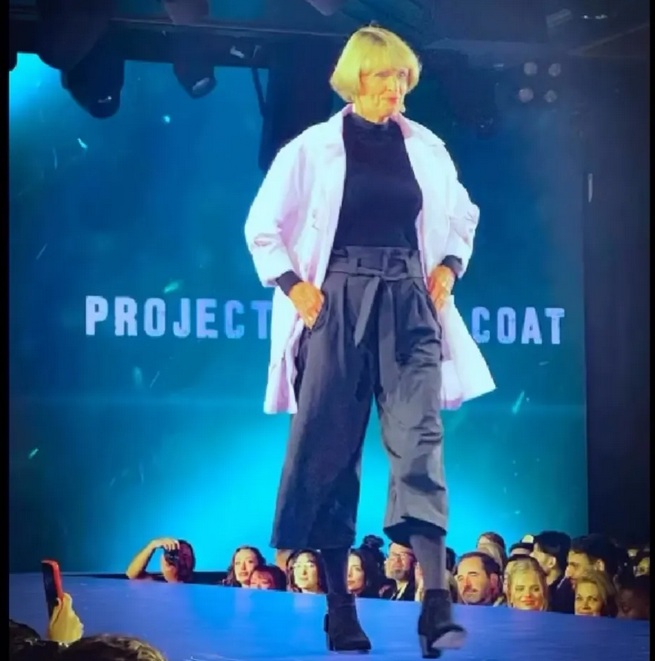
We strode out in lab coats in designs and shades that bespoke the disease. We were hailed, applauded, cheered—pick a verb—by the people we represent, love, and, now, literally stood for. We were on a mission: Raise the profile of, and money for, a scourge that debilitates, diminishes and destroys lives: Ticks. Lyme disease. And a dozen other illnesses that these blood-sucking monsters can deliver in a single, often unseen, bite. Sometimes packing them in twos and threes.
The subject matter is deadly serious. The experience was awesome
Ralph Rosa’s death at 48 from multiple sclerosis ultimately led to Project Lab Coat, in which high fashion uses the runway toward tackling devastating diseases.
A death. An illness. An idea.
Project Lab Coat, as the Fashion Week event is known, is the brainchild of two people who know the toll of illnesses without cures.
Anthony Rosa, founder and CEO of Runway 7, a fashion show production company, lost his brother Ralph in October of 2020 to multiple sclerosis at the age of 48. Christina Kovacs, director of designer and sponsor relations for Runway 7, was “bed-bound for a solid eight years” from Lyme disease.
In December 2020, two months after his brother’s death, Anthony Rosa hired Kovacs, a designer still struggling with the ravages of tick-borne disease. Rosa got it. “I was hired remote,” recalled Kovacs, “and he kept my job remote for me to ensure I could stay healthy and keep thriving.”
Then, as time went on, a conversation began between them. How could they use their platform to help alleviate the suffering both knew close up? Ralph had tried something similar twenty years before he died, using his world, his platform, to change the future of MS.
A guitarist who was diagnosed in 1997, Ralph Rosa set up a foundation for multiple sclerosis research in 2000, using his entertainment contacts to produce an annual comedy show fundraiser. “A-List comedians gravitated towards his infectious smile to help the cause,” according to his obituary.
“I understand what it meant to stand or walk whenever I wanted,” Ralph Rosa wrote in his organization’s nonprofit filing. “Not being able to have that luxury now forces me to have one goal…Aid researchers in finding a cure for Multiple Sclerosis Today!”
Ralph did not see his vision fulfilled, just as Lyme disease patients have seen decades pass without meaningful diagnostic and treatment progress.
In what would eventually lead to now three full-blown fashion shows for good, Runway 7 partnered in 2021 with the Corrine Goldsmith Dickinson Center for Multiple Sclerosis at Mount Sinai Health System. Over eight shows, it has donated $150,000 from ticket sales toward MS research.
Making a statement
Last June, a headline in the business magazine Magnate View dubbed Runway 7 “A Fashion Powerhouse.” Indeed, the company has made a name for itself, winning the Best Fashion Show Platform at the 2024 New York Fashion Awards and other major accolades for inclusion and innovation.
Runway 7’s goal, as reported in the article, is “to revolutionize Fashion Week by delivering inclusive, high-impact, immersive experiences that blend fashion, culture, and social responsibility.”
Project Lab Coat checks the last box, ironically with models sporting lab coats that are not exactly the Dior of style. As in fashion, however, each makes a statement. In the case of Lyme disease, they came in foggy watercolors; angry blotches; patterns that marry Eastern and Western healing; shades of darkness and light; blossoming greens; and intense, unyielding red.
Runway 7 has hosted big names in fashion, including Victoria’s Secret, Naeem Khan, Marc Bouwer, and Nicole Miller. But Kovacs sees Project Lab Coat as “the most important thing that we do.”
“It is definitely very rare in the fashion industry to have any charitable aspirations built into anything,” she told me. “Having that heart is something that’s so important to Anthony and I because we are both personally touched by dealing with invisible illnesses.”

Dr. Eboni Cornish (left) was among five Lyme disease doctors on the runway, on which twenty-four Lyme “warriors” walked.
Next up: Lyme
Lyme disease is so prevalent and life-changing that many in our modeling group of twenty-four thought that someone on the inside must have made this happen, just as Ralph Rosa had inspired the project at the start. It would be someone who had been knocked down, defined, and, ultimately, emboldened by this dreadful illness, an apt description for many people in this community.
Few knew it was the widely known “Lady of Lyme”—Kovacs—who has blogged about her journey since 2011.
After dedicating two shows to multiple sclerosis, Anthony Rosa gave Kovacs full creative control in developing a Project Lab Coat show for Lyme disease.
Fierce Fashion Fighting Lyme
Phyllis Bedford, executive director of LymeLight Foundation, credited Kovacs’ “creative talent, vision, and passion” for the show’s success.
Adopting the motto “Fierce Fashion Fighting Lyme,” LymeLight teamed up with Global Lyme Alliance and Project Lyme in what Bedford called a “historic collaborative project” involving three major Lyme nonprofits.
With LymeLight’s focus on treatment, GLA’s on research, and Project Lyme’s on advocacy, the group signed up a veritable Who’s Who of high-profile Lyme movers and shakers from coast to coast, of which I only humbly include myself. All of us, I’d add, paid our way or their institutions did, braving New York City travel and hotel prices. We wanted in.
“Standing at the event, surrounded by nearly every major Lyme organization represented in the audience or on stage,” said Alexandra Moresco, Project Lyme board chair, “it was clear to me that this community is more determined and resilient than ever before.”
“It felt like the beginning of something bigger than all of us,” said Kenzie Vath, a Global Lyme Alliance executive committee member.
Power of posing
The feeling was mutual backstage, where we waited so long—trading mundane stories and envisioning Lyme’s future—that a bathroom break was needed. Then up came the music, and, for a shining moment, we each walked a thrilling thirty seconds or so under the lights and in front of the cameras. We were united in a cause.
Among us: Scientists Monica Embers of Tulane, and Michal “Mikki” Tal of MIT, who are proving Lyme persists. Winslow Crane-Murdoch and Lindsay Keys whose coincidental doctor visit led to a documentary film. Frontline Lyme doctors Bill Rawls, Eboni Cornish, Myriah Hinchey, Eric Gordon, and Nafysa Parpia.
There were Nicole Malachowski, the nation’s first female fighter pilot, and Elena Delle Donne, who led the WNBA’s Washington Mystics to their 2014 championship—Lyme patients both but not alone. Meghan Bradshaw walked in a green skirt (joyously breaking the wear-black rule under the coats) despite her multiple Lyme-related surgeries that has dubbed her “The Bionic Woman.”
More changemakers

Julia Bruzzese, a 22-year-old college senior, epitomizes the devastation of Lyme disease—and the grit of living with it.
Julia Bruzzese, the girl who met the Pope on an airport tarmac, rocked the runway in her wheelchair.
There were Bennett Nemser, who has guided the disbursement of $100 million for Lyme and tick-borne research from the Steven & Alexandra Cohen Foundation, and Holly Ahern, who is shepherding an ACES Diagnostics Lyme disease test that may be game changing.
These people are molding a new Lyme landscape: Musicians with an edge and a following, like Juj Seely—a ten-year Lyme warrior who received a LymeLight treatment grant—and Kiara Tebyani, collectively known as Z3LLA; and Ren Gill, better known as Ren, a Welsh singer-songwriter who is more than a decade into his Lyme journey.
Add Matt Sabatello and Rich Johannesen, with 500 Tick Boot Camp podcasts online. Olivia Abrams, who is trying to keep people safe from ticks without chemicals. Olivia Flowers, a reality show star who is standing up for her late brother who had Lyme. And Nicola Verses, an entrepreneur whose Lyme led her to educate others.
If there is one in this awesome lineup who inspires me most, it is Julia, who I have written about. No last name is needed among us. She hasn’t folded to Lyme. At age twenty-two, she is on track to become a doctor. She is the definition of resilience, which isn’t to disparage the disabled and discouraged. Julia goes with it. She exudes hope.
That’s at least part of what Ralph Rosa was going for.
We don’t yet know how much Project Lab Coat has raised for Lyme disease. But the public statement it made—replete with the glitz, glamor and, yeah, giddiness—is one small battle won against Lyme disease.
Postscript
I asked Christina Kovacs what the future held for Project Lab Coat—hoping it might include another round for Lyme disease.
Her emailed response was positive.
“We will highlight other causes in future seasons, but if the interest from the community is there to make it even bigger and better then I’d love to explore Lyme disease again down the line! I’m also envisioning an “invisible illness” season which encompasses this community we all overlap with—MS, Lyme, Lupus, MECFS, Fibromyalgia—diseases which people often overlook because they are ‘invisible.’ I think that could have a huge impact in people being seen.”
Mary Beth Pfeiffer is an investigative journalist and author of Lyme: The First Epidemic of Climate Change. She frequently writes for the Rescue substack.






We invite you to comment on our Facebook page.
Visit LymeDisease.org Facebook Page