









PODCAST: Healing from Lyme takes faith, strength, and mitochondria

By Fred Diamond
One of the most misunderstood and under-discussed aspects of chronic Lyme disease is its impact on the brain and on relationships.
During my research for my book on what those related to chronic Lyme survivors need to know, one of my sources estimated that 75% of committed relationships terminated when chronic Lyme was involved.
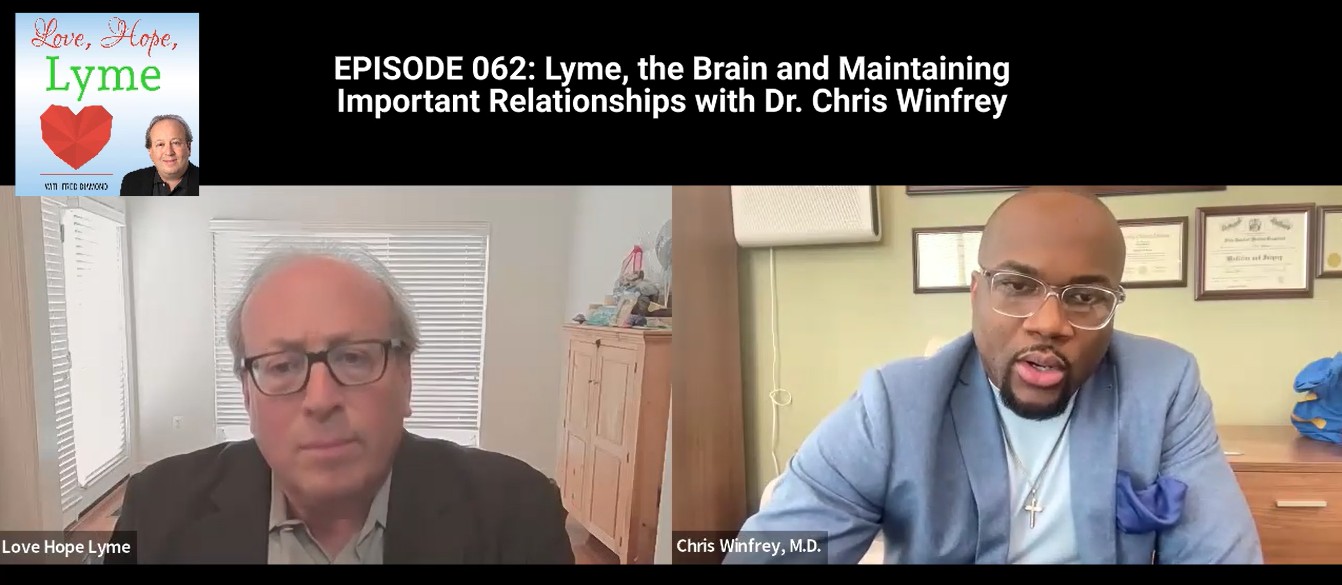
This week’s episode of my Love, Hope, Lyme podcast features Dr. Chris Winfrey, a board-certified psychiatrist at the New Image Wellness Center, in Marlton, New Jersey. He discusses his perspective on how Lyme survivors can improve their quality of life and enrich their relationships.
For many Lyme survivors, mental health challenges are among the most debilitating and isolating symptoms of Lyme. While the public often associates recovery with physical improvements, Dr. Winfrey believes the ultimate measure of success goes far beyond symptom reduction.
“We care about whether we can love, whether we can work, whether we can find and experience purpose in life,” he says. “Those are the outcomes that really matter.”
Beyond Symptom Scores: The Real Goals of Treatment
Too often, treatment progress is measured in lab results, scales, and scores. While those benchmarks have their place, Dr. Winfrey urges patients and providers to keep their focus on what makes life worth living.
“When someone has a chronic, complex illness like Lyme, one or more of those fundamental areas, such as relationships, work, or purpose, are usually impacted,” he said. “That’s why I think about quality of life as the true outcome.”
The reality, he added, is that many Lyme survivors live with unrealized potential because their illness robs them of energy, clarity, and confidence. That loss doesn’t just affect them individually; it strains family dynamics, friendships, and marriages.
The Limits of Traditional Psychiatry
Traditional psychiatry, Dr. Winfrey explains, often plays a role in Lyme recovery, especially in maintaining safety by protecting against self-harm, aggression, or impaired judgment. Psychiatric medications can be helpful in certain cases, particularly when symptoms are mild or short-term. But they are rarely curative for chronic illness.
“Medications can reduce the intensity of a symptom,” he says, “but they rarely resolve the underlying problem.”
He cautions patients against expecting a “one-pill fix,” noting that pharmaceutical marketing has ingrained an unrealistic idea that a single prescription can restore full health. This misconception can prevent patients from pursuing the multi-pronged, sustained treatment approaches that chronic Lyme often requires.
Metabolic and Mitochondrial Psychiatry: Addressing the Root
Instead of starting with symptom labels like anxiety or depression, Dr. Winfrey focuses on restoring cellular health and particularly mitochondrial function.
“Mitochondria are the energy factories of the cell,” he explains. “If we support them with the right nutrients, such as magnesium, B vitamins, vitamin D, and CoQ10, we can begin to reverse fatigue and brain fog.”
His first priorities with new patients are boosting energy and improving mental clarity. Why? Because without energy, every other aspect of recovery such as detoxing, immune function, even emotional processing becomes much harder.
“Oxygen is the most important treatment.You need energy to sleep, to wake up, to move, to love, to think. You can’t do this treatment without energy.”
Why Strength Training Matters for Lyme Recovery
One of Dr. Winfrey’s more unconventional recommendations for Lyme survivors is strength training.
It’s not about weight loss, he stresses, but about building muscle to increase mitochondrial density. The heart, brain, and muscles are the body’s top energy consumers. Muscles can be strengthened relatively quickly through targeted exercise.
“Lyme and mold significantly target the muscles,” he explains. “When kids slump forward or adults lose posture, it can be due to muscle weakness, not laziness or disinterest.”
For patients too fatigued to consider the gym, he focuses first on adrenal and thyroid support, nutrition, and targeted supplementation which lays the groundwork so they can tolerate physical activity when ready.
How Lyme Impacts the Brain
According to Dr. Winfrey, one of the main ways Lyme affects the brain is by slowing its electrical activity. EEG scans often reveal excessive delta and theta waves, the same slow-wave patterns seen in sleep. when the patient is fully awake.
“That means you’re walking around as if your brain is asleep,” he says. “Your processing speed is slow, and that can cause misunderstandings in relationships and social situations.”
Lyme also damages the myelin sheath and cell membranes of nerve cells, reducing their ability to transmit signals effectively. This “low-voltage brain” struggles with decision-making, organization, impulse control, and emotional regulation.
In children or those infected early in life, the disease can disrupt normal brain development, particularly in the frontal lobe which is the area responsible for executive functions and personality.
Emotional Hijacking of the Limbic System
Dr. Winfrey explains that Lyme can “hijack” the limbic system, the brain’s emotional center, altering thoughts and feelings in ways that can be deeply unsettling.
“Emotions drive thoughts,” he says. “Lyme can make you think things you wouldn’t normally think if you didn’t have it. That includes thoughts of self-harm which are not natural human thoughts. They are symptoms of brain circuitry being changed by disease.”
This distinction is crucial for reducing shame and encouraging patients to seek help. “These are not your own thoughts,” he emphasizes. “They are a product of what’s happening in your brain.”
Dr. Winfrey is clear that recovery is possible, but it requires a comprehensive approach.
“You need to get the infection out, control inflammation, repair cellular damage, restore blood flow and hormone signaling, and then retrain the brain’s rhythm.”
He uses tools like transcranial magnetic stimulation (TMS) to help “conduct” the brain’s activity, so different regions communicate effectively.
Most importantly, he advises patients not to arbitrarily dismiss potential treatments for ideological reasons: “You need every tool in the toolbox.”
Faith as a Healing Tool
Faith, both in the religious sense and as a basic human capacity to believe in a better future, plays a powerful role in recovery, according to Dr. Winfrey.
At its core, he says, faith is “the ability to see and imagine something as possible when you don’t yet have evidence for it.” For many chronic Lyme patients who have never seen someone close to them recover, this can be difficult.
Without that belief in a future self, motivation and resilience can falter. Studies also show that those with faith, regardless of its specific focus, tend to have less inflammation and better stress regulation.
For Dr. Winfrey, healing isn’t just about biology. It’s also about connection.
“Healing happens in relationships,” he says. “It’s not just the modulation of biology. Having the right relationships and the right artistry to this approach is key.”
Strong, supportive relationships provide both emotional grounding and practical support during the long, often frustrating journey of Lyme treatment. Conversely, strained or broken relationships can slow recovery and increase isolation.
Despite the immense challenges of chronic Lyme, Dr. Winfrey remains deeply optimistic.
“I think this is the best time to be alive at any point in history,” he says. “Out of eight billion people on earth, somebody knows something. I refuse to believe we can’t get this done.”
For survivors who feel stuck, his advice is to keep going, keep seeking, and keep building both physical and emotional strength.
“It’s an art as much as a science,” he said. “How you put it together matters. And I believe that resolution is possible.”
Click here to listen to all episodes of the Love, Hope, Lyme Podcast or on YouTube.
Fred Diamond is based in Fairfax, Virginia. His popular book, “Love, Hope, Lyme: What Family Members, Partners, and Friends Who Love a Chronic Lyme Survivor Need to Know” is available on Amazon. The e-version (pdf) of the book is always free to Lyme survivors. PM Fred on Facebook or LinkedIn for your copy.





We invite you to comment on our Facebook page.
Visit LymeDisease.org Facebook Page