








PODCAST: When chronic Lyme disease puts marriage at risk

By Fred Diamond
A Lyme advocate once shared with me that they estimated that 75% of committed relationships will terminate when chronic Lyme is involved.
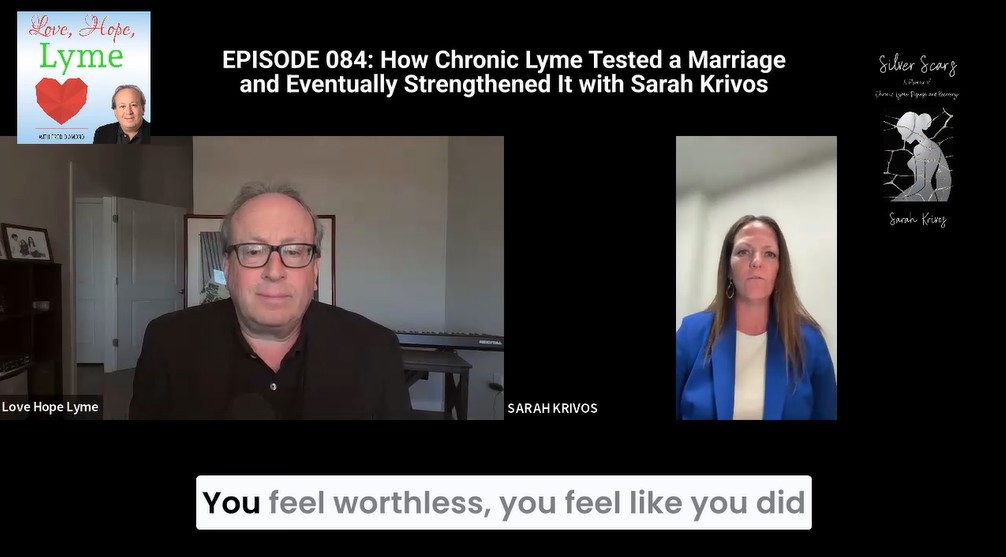
On this week’s episode of the Love, Hope, Lyme Podcast, Sarah Krivos, author of Silver Scars: A Memoir of Chronic Lyme Disease and Recovery, shares an honest account of how Lyme disease nearly cost her marriage and what ultimately helped save it.
Chronic Lyme disease doesn’t just affect the person who is sick. It affects spouses, children, friendships, careers, and nearly every aspect of life. The fatigue, pain, brain fog, mood changes, and uncertainty that often accompany Lyme disease can place enormous strain on even the strongest relationships.
For many couples, the stress becomes overwhelming and misunderstandings grow. Communication breaks down and resentment builds. Some relationships don’t survive.
Sarah’s story offers hope for couples who may be struggling to navigate the challenges of chronic illness together.
When Lyme changed everything
Sarah’s Lyme story began long before she understood what was happening.
Bitten by a tick as a child and diagnosed with Lyme disease twice before the age of 10, she spent much of her life dealing with unexplained symptoms that seemed to come and go without answers. Then, in her late thirties, her health deteriorated dramatically.
“I got really, really, really sick very quickly,” Sarah says. “I honestly did not think that I would live to see 40 years old.”
Like many Lyme survivors, she embarked on a frustrating search for answers. She saw countless medical professionals, explored alternative approaches, and eventually identified chronic Lyme disease as the root cause of her suffering.
But while her health was declining, another struggle was unfolding inside her home.
Before becoming seriously ill, Sarah would describe herself as energetic, social, adventurous, and always ready for the next activity. As Lyme symptoms intensified, that version of herself seemed to disappear.
“I used to be this fun, playful vixen, down for anything,” she says.
Instead, she found herself exhausted, overwhelmed, and wanting nothing more than to stay in bed and rest. The changes affected every aspect of her marriage.
Diminished self-esteem
Like many Lyme survivors, Sarah lost her sense of self-worth.
“You feel worthless,” she says. “You feel like you did something wrong. You feel like you caused this.”
As those feelings intensified, she began pushing away the person who loved her most. She admits that she often lashed out at her husband, Dan. She carried anger, resentment, and frustration that she could not fully explain. Looking back, she realizes that much of that anger wasn’t truly directed at him.
It was directed at the illness. At the uncertainty. At the loss of the life she once knew.
“We tend to hurt those who are closest to us,” she says.
One of the greatest challenges was that she couldn’t explain what she was experiencing.
“He didn’t really understand what was happening because I couldn’t communicate it to him,” Sarah says. “I didn’t fully understand what was happening myself.”
For many Lyme patients, that statement will sound painfully familiar.
When brain fog, fatigue, neurological symptoms, and emotional turmoil become part of daily life, finding the words to describe what’s happening can feel impossible. Yet spouses are often left trying to understand dramatic changes in behavior without any roadmap.
Learning to fight for the marriage
As her illness continued, Sarah eventually sought help beyond physical treatment. She began working with an emotional coach and discovered that many of the challenges she faced extended beyond Lyme disease itself.
During that process, she explored significant traumas from earlier in her life, including the deaths of her mother, grandfather, uncle, and brother. For years, she had buried those experiences and simply kept moving forward.
“I had no idea the correlation between past trauma and what’s really stored in your body from that, and how it can affect you physically,” she says.
The coaching process helped her identify patterns she had never fully recognized, including codependency and unhealthy communication habits.
Eventually, Dan joined the process as well. Together, they began couples coaching and started examining not just the disease, but how it was affecting their relationship.
Differing perspectives
One breakthrough came when Sarah realized that she and Dan were fighting entirely different battles. Her primary focus was healing. His primary focus was holding everything together.
While Sarah was consumed by doctor appointments, symptoms, treatments, and survival, Dan was trying to maintain financial stability, support their children, manage household responsibilities, and preserve their family.
Neither perspective was wrong, but because neither fully understood the other’s experience, conflict grew.
“Illness impacts both partners,” Sarah says.
One exercise became especially meaningful. Their coach asked them to create what she calls a marriage statement. Sitting together, they took turns writing down what they needed from one another as partners.
The exercise forced them to become vulnerable in ways they had never been before. Once completed, they taped the statement to their bathroom mirror and read it every day.
“It was a gentle reminder of, ‘Hey, this is what my partner needs from me,'” Sarah says.
What sounds simple on paper became a powerful tool for rebuilding communication and trust.
Stronger than ever
As Sarah’s health gradually improved, something else happened. For the first time, she became able to hear Dan’s side of the story.
During a conversation while walking together, he finally felt comfortable sharing how the years of illness had affected him.
Sarah listened, and what she heard changed her perspective.
“I just sat there and I was like, ‘Wow, I was terrible to him. I was terrible,'” she says.
The moment wasn’t about blame. It was about understanding. For years, Sarah had been focused on surviving. Only later was she able to fully appreciate how much her husband had been carrying as well. That realization became another step toward healing.
Today, Sarah says their marriage is stronger than ever. Not because Lyme disease was easy, and not because they avoided conflict.
Their marriage survives because they have learned how to communicate honestly, seek help when they need it, and remain committed to one another even during the most difficult moments.
For spouses supporting someone with Lyme disease, Sarah offers simple but powerful advice: keep asking questions, keep showing love, and keep reminding your partner that you’re there.
Healing is possible
For Lyme survivors, she encourages listening to your body, honoring your limitations, and remembering that healing is possible.
“Remission is absolutely possible,” she says.
Perhaps most importantly, Sarah says her perspective changed when she stopped asking, “Why is this happening to me?” and started asking, “Why is this happening for me?”
Today, she sees purpose in sharing her story.
For the countless couples facing Lyme disease together, her experience serves as a reminder that while chronic illness can test a marriage in unimaginable ways, it does not have to define its ending.
Click here to listen to all episodes of the Love, Hope, Lyme Podcast or on YouTube.
Fred Diamond is based in Fairfax, Virginia. He doesn’t have Lyme but wrote his popular book, “Love, Hope, Lyme: What Family Members, Partners, and Friends Who Love a Chronic Lyme Survivor Need to Know” to understand what Lyme survivors go through. The book is available on Amazon and the e-version (pdf) of the book is always free to Lyme survivors. PM Fred on Facebook or LinkedIn for your copy.




We invite you to comment on our Facebook page.
Visit LymeDisease.org Facebook Page